

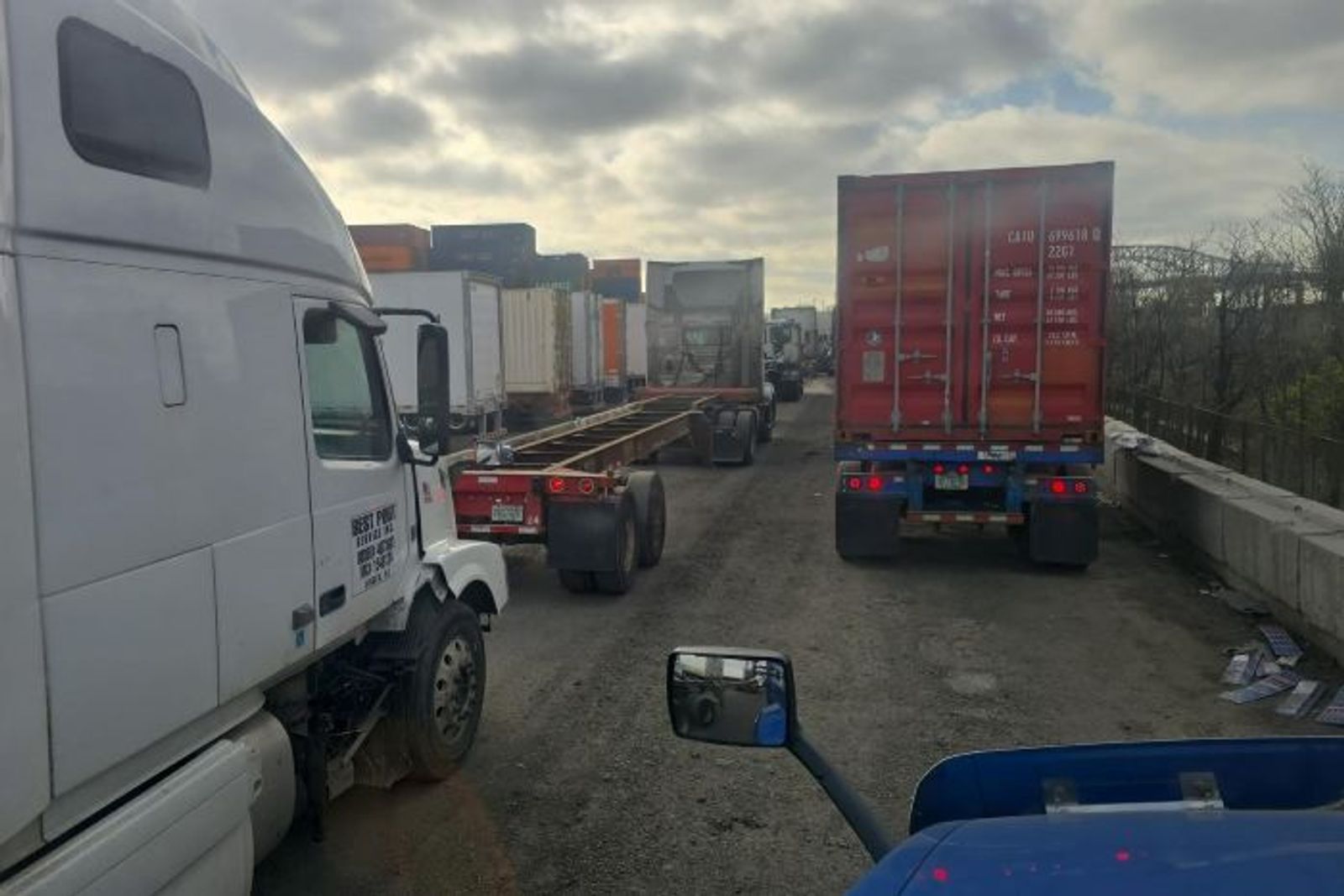
The Port of New York and New Jersey is expanding the fee it charges ocean carriers for long-dwelling empty containers to include off-dock depots outside of the port, a move that comes as port truckers face increasingly long and frequent delays when returning empties.
But trucking interests question whether the now three-year-old fee will ever effectively address the port’s bouts of empties congestion, which impacts shippers downstream through delayed container returns and detention costs.
In an April 1 email, the Port Authority of New York and New Jersey (PANYNJ) notified ocean carriers and other stakeholders about the revised marine tariff that will go into effect May 1. One of biggest changes to the tariff is in the “container imbalance fee,” which the port first instituted in 2023 to incentivize ocean carriers to remove the pandemic-era backlog of empty containers at NY-NJ.
Along with new language that says ocean carriers must “proactively and regularly manage” their empty container inventories, the revised tariff also references empties lingering at “nearby depots” along with marine terminals on PANYNJ property.
The PANYNJ said the container imbalance fee always considered empty containers at off-port depots, even if not explicitly stated in the original tariff. Port Director Bethann Rooney said in a statement the revised tariff reinforces the imbalance fee program, which also has a new formula for calculating the excess empties that face the $100-per-container fee.
“The container imbalance fee is a key tool, helping reduce congestion caused by excess empty containers,” Rooney said. “This ... update strengthens the programs with clearer terms and greater accountability, ensuring our port remains one of the most reliable and fluid gateways in the country.”
Hundreds of trucks turned away
The trouble for truckers, though, is reliability and fluidity just outside of the port.
APM Terminals contracted with one off-dock facility, Port Newark Depot (PND), in February 2025 to handle the empties from Maersk and Hapag-Lloyd as they started services under the Gemini Cooperation alliance.
APM said in a statement the off-dock empty yard “helps preserve on-terminal space for full cargo moves and reduces gate congestion ... while giving truckers the flexibility to pick up empties for export and return them off-terminal when appointments are constrained.”
However, Port Newark Depot also faces bouts of congestion and delays that have been frustrating truckers.
“The on-street backups waiting to enter the depot have remained significant,” the Association of Bi-State Motor Carriers said in its April newsletter, “Desperate truckers often line up several hours before the depot opens, contributing to the backups and causing traffic delays.”
While sporadic, Bi-State President Lisa Yakomin said motor carriers have reported that drivers face four- and five-hour wait times to get into Port Newark Depot, putting truckers at risk of running out of service hours.
Yakomin said Port Newark Depot is trying to manage the truck queues with a few relief measures, including signs showing the waiting times, adding another container handling machine, and providing return instructions to drivers the day prior.
But the sheer volume of empties can still overwhelm the 12-acre facility. Yakomin said a three-mile-long line of approximately 500 trucks was turned away from returning empties on April 10 because Port Newark Depot was full by late afternoon.
“APM chronically runs out of appointments for returning empties, so PND is taking the overflow,” Yakomin said. “But if the marine terminal can’t handle it, how can a single depot? Expecting one depot to absorb the empties is unrealistic.”
To address the overflow, APM said in a notice last week to truckers that an additional PND lot will be open for receiving Maersk and Hapag-Lloyd empties. The additional four-acre site can handle between 1,600 and 2,000 empty containers. Port truckers have also been directed to a recently opened 35-acre site, World Wide Depot, for returning empty containers belonging to Zim Integrated Shipping Services. That site is on the same plot of land as PND.
But Yakomin said more off-dock space for empties will just mean more off-dock congestion. The issue is being exacerbated by instances of truckers receiving conflicting empty return information from an ocean carrier and a marine terminal, she said, adding to motor carrier costs by sending truckers on dry runs.
“The more room you give the ocean carriers to dump their empties and let them languish, they will use it,” Yakomin said.
Next step could be FMC
The PANYNJ said in its statement that “while [the current imbalance fee] has been largely effective, some congestion has taken place if and when ocean carriers allow containers to accumulate to a critical point.” To avoid that, the PANYNJ said the new tariff shortens the evaluation period for determining excess empties from one year to six months.
However, Yakomin said it is not clear if that represents any improvement, given the previous tariff referenced a quarterly period for assessing excess empties. Despite the previous tariff being in effect since 2023, the port still has bouts of empty congestion, Yakomin said.
“The ocean carriers need to be held accountable for not removing their empties in a timely manner,” she said. As for updating the imbalance fee program, “that’s a little too late.”
Yakomin said the next recourse is through the US Federal Maritime Commission, which might have leverage into the issue due to the billing questions raised by empty returns.
She said it is not clear whether ocean carriers are charging shippers detention on an empty container that had a return location but was full.
Inconsistent empty return instructions would also appear to violate FMC rules on providing accurate billing information. Moreover, motor carriers still face being shut out of marine terminals for unpaid detention bills, Yakomin added, a further violation of FMC billing rules.
“We would like the FMC to take a look at incorrect billing, but also more clearly define accessibility for an empty return location,” she said.