

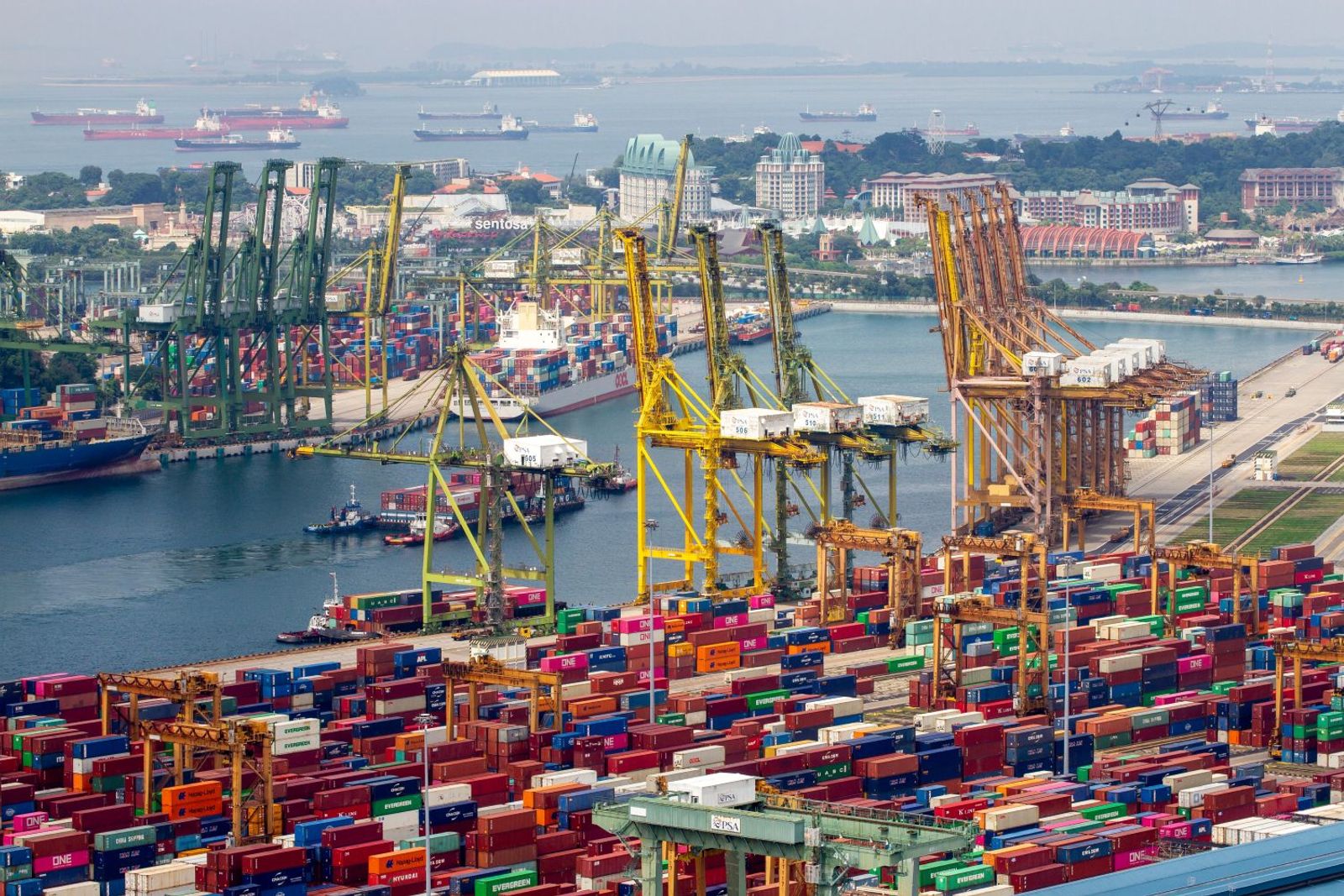
Bad weather, particularly in China, and vessel bunching are making congestion worse at ports in Asia, leading ocean carriers to drop calls on both mainline east-west and intra-Asia services, carriers and forwarders say.
Congestion has been exacerbated by longer ship dwell times due to increased cargo volumes, especially on trans-Pacific trades as shippers frontload freight ahead of new US tariffs that are expected later this month, the sources added.
The worst affected ports, sources say, include Shanghai, Ningbo and Shenzhen’s Yantian terminal in China, plus Singapore, Busan in South Korea, and Colombo in Sri Lanka.
“Port delays are ever-present, but congestion in China had been improving until recently with 24- to 36-hour waits in Shanghai and Ningbo,” a senior executive at an Asian regional carrier told the Journal of Commerce. “Now congestion is worsening with carriers omitting ports or dropping sailings.”
The source said delays and port congestion in Asia are “likely to deteriorate further over the coming weeks.”
Peter Sand, chief analyst at benchmarking platform Xeneta, said port congestion, especially at Southeast Asia and South Asia transshipment hubs such as Singapore, Colombo, and India’s Nhava Sheva, is fueling a second wave of Red Sea-related freight rate disruption.
“Congestion ripples across global supply chains,” Sand told the Journal of Commerce. “As effective as they may be, it’s not enough to avoid this crunch.”
Global port congestion at four-year high
The delays in Asia have helped propel global port congestion to a four-year high, with almost 11% of the container fleet, equivalent to 3.7 million TEUs, currently waiting at anchorage as of June 28, according to Linerlytica.
Congestion, coupled with strong cargo demand and constrained vessel deliveries, have helped increase both freight and charter rates as the Shanghai Container Freight Index breached 3,200 points, with the momentum “expected to last for at least another month,” Tan Hua Joo, co-founder of the Linerlytica platform, said in a commentary this week.
Shanghai is currently the worst for delays in Asia, with up to a five-day wait at terminals at the deepwater facility on Yangshan island.
“[This is] primarily due to concentrated mainline arrivals and longer port stays resulting from increased operational volumes,” forwarder Kuehne + Nagel said.
Fog led to the closure of both Yangshan and the downtown Waigaoqiao terminals on June 19, which has caused knock-on delays over the last 10 days.
Hapag-Lloyd said there is an “average waiting time of approximately 60 hours for Gemini, [and] 96 to 120 hours for non-Gemini services” in Shanghai.
Gemini has omitted Shanghai on at least one trans-Pacific service due to congestion, while Hapag-Lloyd and partner Ocean Network Express (ONE) have dropped the port from seven of their joint Asia-Latin America services.
Dense fog also affected nearby Ningbo, causing pilot services to be suspended and leading to congestion and vessel bunching that resulted in berthing delays of up to two days, Hapag-Lloyd added. That led to the port being dropped last week from two joint Hapag/ONE Latin America services.
High container yard utilization in Ningbo has also impacted productivity, resulting in longer vessel port stays, Kuehne + Nagel said.
Linerlytica said there were 155 ships waiting at anchorage at Shanghai and Ningbo on June 28, with a further 105 ships within the respective port limits.
Portcast data on the Journal of Commerce Gateway platform shows there were 84 vessels in Shanghai and 39 in Ningbo as of June 22. The Shanghai figure is more than double what it was in mid-April.
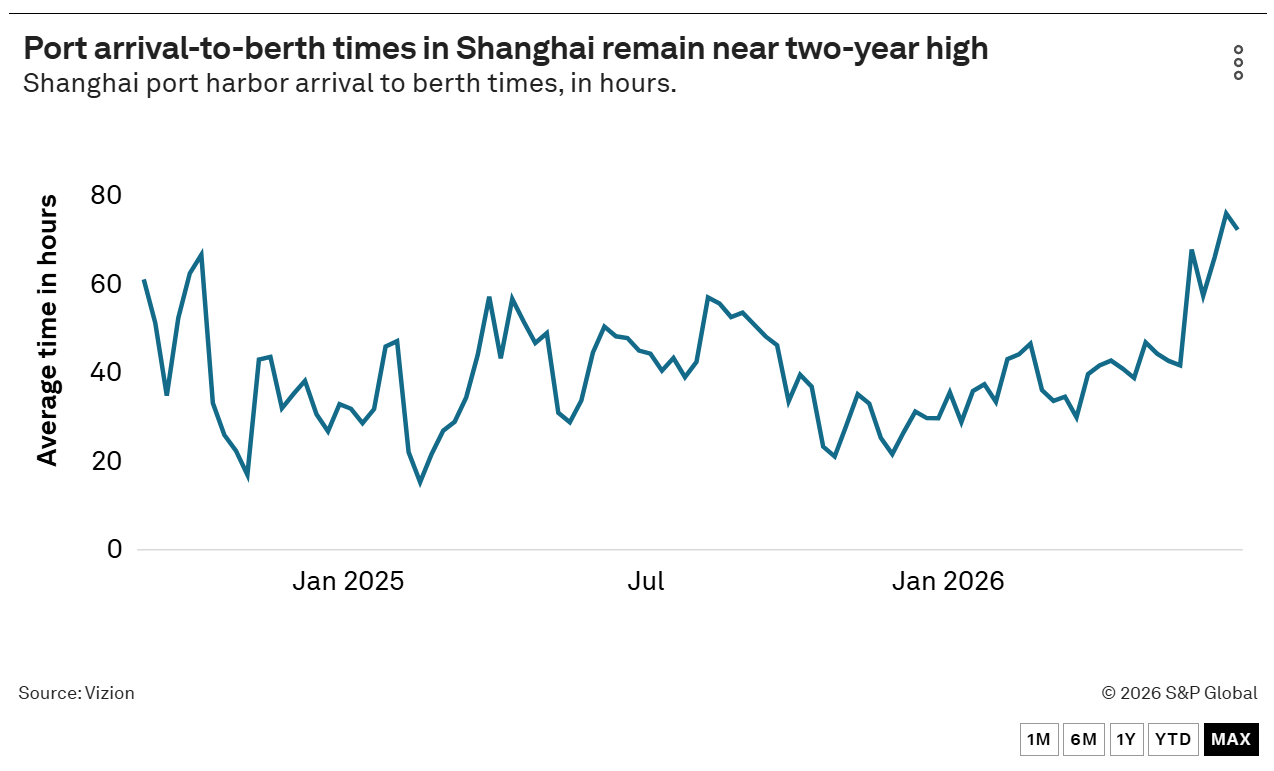
Data from Vizion indicated as of June 22, it took a vessel an average of 72 hours to land at berth in Shanghai after arriving in port. That’s the second-highest figure going back to at least August 2024, behind only 76 hours on June 15.
Singapore, Jakarta battling congestion
Singapore has also been affected by increased congestion. Hapag-Lloyd said the average berth waiting time was just 15 hours for Gemini services, but 60 hours for non-Gemini services.
Singapore-based ONE has faced even longer delays, with waits of up to 12 days there on some intra-Asia services. One sailing on its Japan-Indonesia service last month, scheduled to take 16 days between Kobe and Jakarta, actually took 24 days even with a dropped call at Shimizu, mainly due to delays last week in Singapore.
ONE said a three-day wait in Singapore, coupled with typhoon-related delays in Japan, led to a Japan-Singapore-Malaysia service lengthening from 15 to 20 days despite a port omission at Nagoya last month.
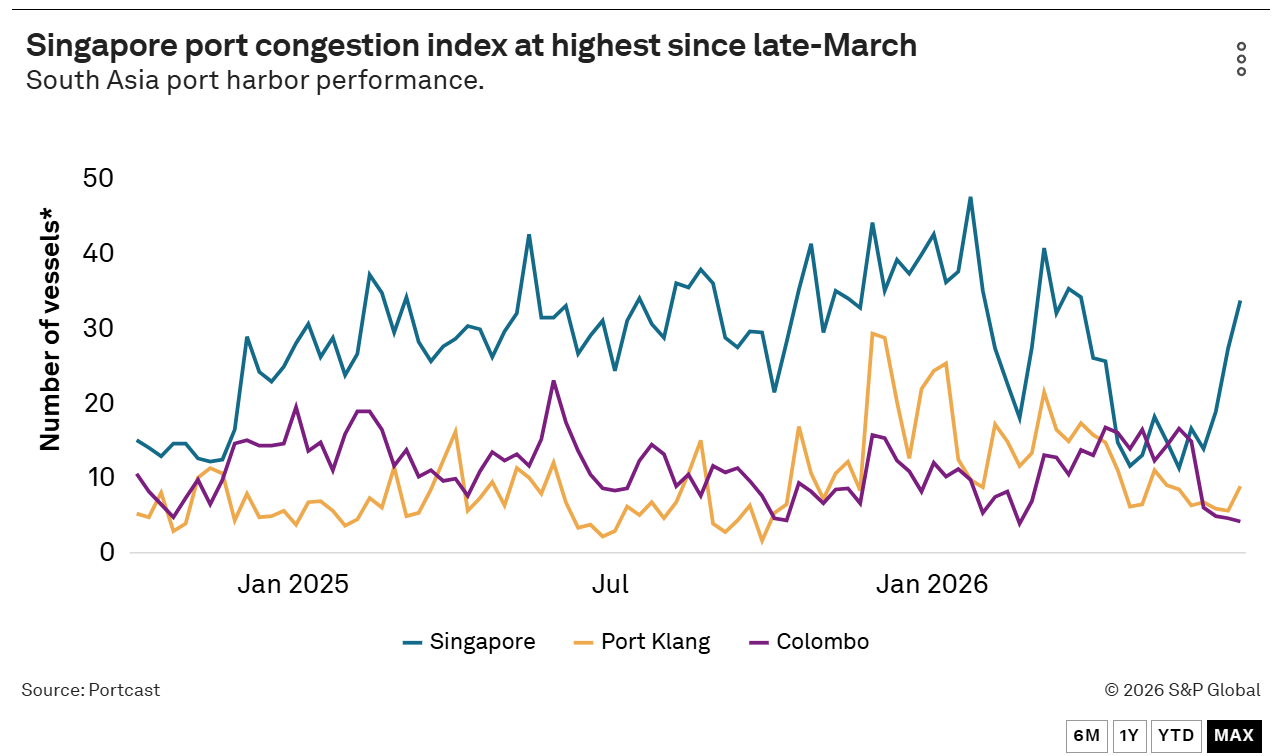
An index from Portcast that measures port congestion was at its highest on June 22 since late March.
In neighboring Indonesia, lengthy delays of a week and more at ports including Jakarta and Surabaya have affected services operated by Hapag-Lloyd and CMA CGM and its regional affiliate CNC, the carriers said.
Busan, North Asia’s main transshipment hub, is experiencing delays of between two and five days depending on the terminal, Hapag-Lloyd said.
In Colombo, there are delays of at least two days with congestion caused by “Middle East cargo diversions and high yard utilization and inter-terminal delays affecting terminal productivity,” Kuehne + Nagel said.
“For regional carriers like us, congestion-related delays are a real problem because even slippage of two or three days can cause havoc to sailing schedules,” the Asia-based carrier executive said.
“It’s time that’s difficult to catch up for ships calling at multiple ports on a two- or three-week voyage,” the source added. “For ships facing longer delays, we have to drop calls, roll cargo or deploy ships to make ad hoc calls to load the missed freight.”
Mainline carriers including Hapag-Lloyd and CMA CGM have also announced cargo will be either rolled to a future service or transshipped at other ports, such as Ningbo for Shanghai and Busan cargo, and then shuttled back to the destination port.