

Container slot space from Asia to the US West Coast this early peak season is easing thanks to new capacity injections but remains tight to the US East Coast for a variety of reasons, including Panama Canal restrictions.
That disparity in tightness is reflected by the wider-than-normal spread between spot rates to both coasts, with prices to the East Coast holding or dipping while those to the West Coast fall, according to the Shanghai Shipping Exchange and Platts indexes.
The gap between rates as measured by the two indexes last week was $2,500 and $3,000, respectively, compared with a traditional spread of $1,000.
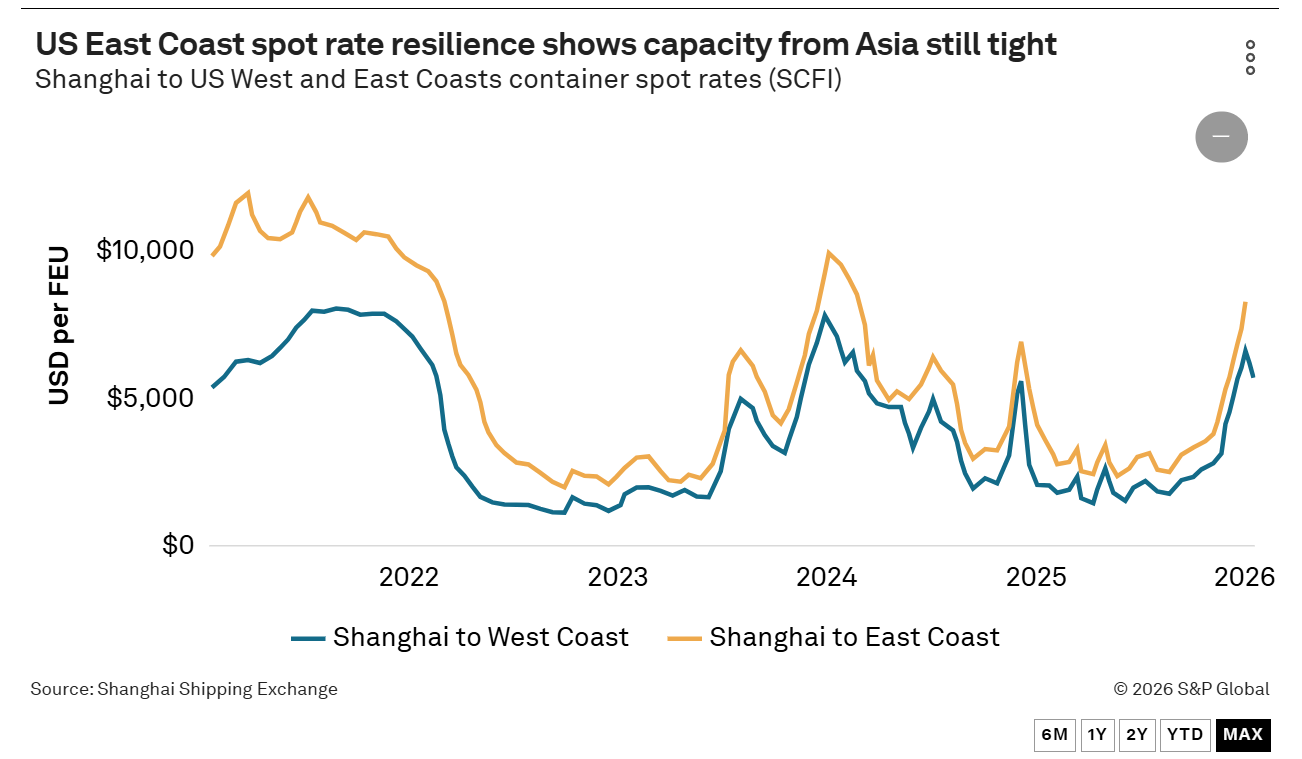
Space remains especially tight and spot rates higher than usual from Asia to the East Coast primarily because carriers have not deployed much extra capacity in the form of extra-loader vessels on that lane. Ocean carriers ramped up tonnage deployment to the East Coast and Gulf Coast by a quarter between June and July and are set to keep topping up tonnage into August, according to benchmarking provider Xeneta’s eeSea data.
Drought-driven water restrictions at the Panama Canal have further contributed to tightness, according to a senior executive at a Europe-based ocean carrier.
Elevated bunker fuel prices, driven by the disruption in the Strait of Hormuz, also impact how carriers deploy capacity, said Patrick Fay, CEO of BOC International. Roundtrips to the West Coast not only burn less fuel but also avoid Panama Canal fees or even higher fuel prices through transits via the Cape of Good Hope, making deployments to the former an easier lever for ocean carriers to pull when demand rises.
“Blank sailings and carrier capacity management are also contributing. Some of the earlier capacity reductions appear to have affected East Coast services more heavily, leaving less available space as demand has increased,” Fay said.
During the past two months, space to the US East Coast was so tight that carriers frequently “rolled” containers at Asian load ports, forwarders told the Journal of Commerce. The incidences of container rolling appear to have diminished.
“Space is still very tight to the East Coast, but there’s nothing significant in terms of rolling. I wouldn’t call it significant at all,” said Rachel Shames, vice president, pricing and procurement at the forwarder CV International.
Capacity on all-water services from Asia to the US East Coast could be further restricted if El Niño weather predictions by some sources materialize in the coming months. The Panama Canal Authority on Tuesday announced its second tightening of transit restrictions to take effect on Friday.
Most holiday merchandise was frontloaded
Imports from Asia should remain relatively strong at least into September, according to industry sources.
“I would be really surprised if we don’t see volumes strong past Labor Day,” said David Bennett, chief commercial officer at Port X Logistics.
Due to frontloading since spring, most of that traditional peak season cargo has already arrived at US ports. US retailers will bring in record volumes this month but will pull back on importing through at least November, as reflected by year-over-year declines, according to the widely watched Global Port Tracker.
“I’m fairly positive [the frontloading] did include quite a bit of holiday merchandise. It may be the case that we’re at or near the peak,” James Caradonna, executive vice president of forwarder Spedag Americas, told the Journal of Commerce Tuesday.
Even with capacity loosening to both coasts, some carriers are not being deterred from seeking yet another general rate increase (GRI) on Aug. 1, a forwarder said. One carrier this week posted an Aug. 1 spot rate of $10,500 per FEU to the East Coast, up from $8,800, and $7,250 per FEU to the West Coast, up from $5,700.
“They’re trying to get the best utilization they can for the next 10 days because their customers will be fearful of an Aug. 1 GRI,” the forwarder said.
He added, though, “I think trying to elevate the East Coast rates to $10,000 is a bit fanciful.”
Tariffs’ impact yet to be determined
Still to be determined is the impact of tariff changes on the trans-Pacific trade. The implementation of new, possibly higher tariffs is widely expected to take place on July 24, but the administration has said little on that topic recently.
Even if there is no formal announcement by the administration by Friday, the details will likely play out over the next couple of weeks and the effective date of any tariff changes will eventually be announced, the consultant said.
If time-to-market to meet the tariff deadline becomes a factor, “They’ll pump it into the West Coast because the transit time to the West Coast is quicker,” the consultant said.
Jason Cook, CEO of Ardent Logistics, said quick implementation of new, higher tariffs in the coming month could divert some imports from Asia to the shorter, faster routes through the West Coast.
“How long the East Coast remains tight will be driven by tariff action. The party could be over in the next two to three weeks,” Cook said.