

The extent to which ocean carriers can get new container rate increases on the eastbound trans-Pacific to stick after Aug. 1 will demonstrate just how much staying power this early peak season has left.
Despite US retailers signaling they will start to pull back on imports beginning next month, volume projections for the next few weeks from the ports of Los Angeles and Long Beach, as well as anecdotal reports from forwarders, have left the door open for an August rate rally.
Indeed, some initial data suggest that could happen. After falling since mid-July, spot rates from North Asia to the US West Coast ticked 1% higher week over week to $5,850 per FEU as of July 28, according to Platts, a sister company of the Journal of Commerce within S&P Global. The East Coast rate was 1% lower week over week at $8,850 per FEU.
The larger trans-Pacific carriers this week have notified customers of general rate increases (GRIs) in excess of $1,000 per FEU to the West and East coasts that will go into effect Aug. 1. What’s more, unlike previous GRIs this spring that began to deteriorate shortly after they took effect, forwarders and industry consultants say the new increases will be “sticky.”
“It seems most importers are feeling the sense of urgency and are pushing suppliers to ship now, if possible,” an industry consultant who formerly managed logistics operations for large, big-box retailers, told the Journal of Commerce. “I can’t believe I’m saying this, but I suspect these rates will stick, for now.”
And that has some forwarders baffled, especially since many expected the trans-Pacific rate surge to run out of steam once the frontloading that began in the spring ended in late July upon the implementation of new tariffs by the Trump administration.
“Everybody is so surprised about it,” said Ann Wilkinson, trade lane manager/trans-Pacific at the forwarder Rohlig Logistics. “This peak season started in May and there seems to be no end in sight.”
Still, import volume projections through mid-August for the Los Angeles-Long Beach port complex — the largest US import gateway that handles about half of all imports — confirms that demand is strong as the traditional August-through-October peak season kicks off.
According to data published on their websites, a robust 200,000 laden TEUs of imports will pass through the port complex each week through mid-August.
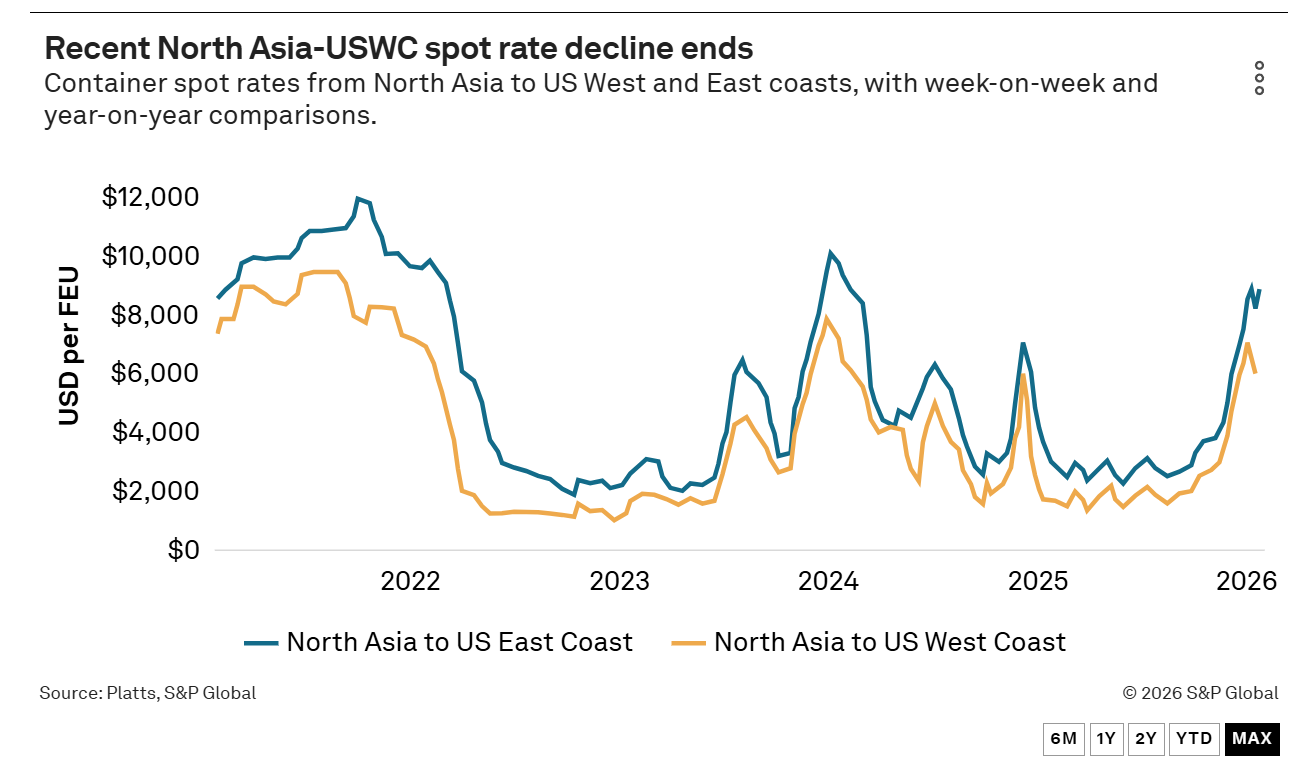
Forwarders say the coming GRIs will push the spot/FAK (freight-all-kinds) rates to about $7,000 to $7,200 per FEU to the West Coast and about $10,000 to $10,200 per FEU to the East Coast; those ranges were confirmed by executives at three carriers. It would be the highest spot rate for East Coast business in two years.
Serkan Kavas, executive vice president for imports at the forwarder MTS Logistics, said demand on the trade lane “remains resilient.”
“I think carriers are trying to stop the recent West Coast rate correction and rebuild rates in August,” he said. “Whether those GRIs stick will largely depend on whether additional West Coast capacity remains in the market.”
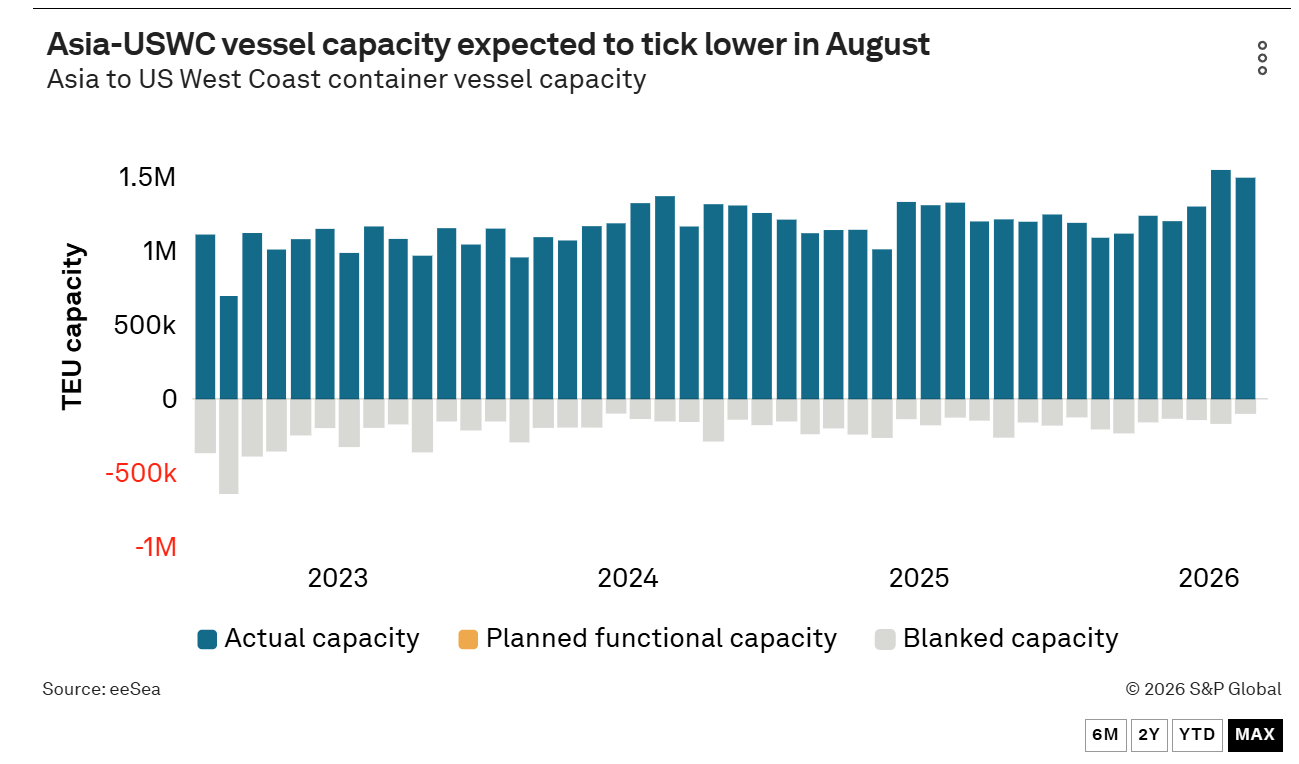
Initial signs point to August capacity declining. According to Xeneta’s eeSea, capacity from Asia to the West Coast in August is pegged at just over 1.5 million TEUs, down about 3% from 1.55 million TEUs in July.
Ocean carriers on the eastbound trans-Pacific have expertly adjusted capacity to meet record import demand ahead of the end-of-year holidays, avoiding severe rolling pools while also holding shippers to their contracted volumes.
The mix of cargo booked with non-vessel-operating common carriers (NVOs)and carrier-direct bookings has also shifted to favor NVO bookings. The percentage of NVO bookings in June was 53.5%, up from 50.4% in March. The percentage of carrier-direct bookings in June was 46.5%, down from 49.6% in March, according to PIERS, a Journal of Commerce sister product.
‘Multitude’ of reasons for sustained cargo surge
One carrier executive cited a “multitude of reasons” for the continued strength in the eastbound trans-Pacific, including low inventory levels that are generating re-stocking, inaccurate initial import forecasts from retailers, the sale of some brands that were struggling earlier in the year but have since turned around, strong imports of hardware linked to AI data center buildouts, and defense spending.
“Everyone probably has a different theory or perspective, but demand continues to be stronger than [originally] thought,” the carrier executive said.
Extra-loaders deployed by carriers to the West Coast have prevented the large spot/FAK rate gains from keeping up with East Coast increases and in part accounts for the unusually large spread of about $3,000 per FEU between East and West coast rates. The spread is normally closer to $1,000.
“On the West Coast, you have seen spot rates drift down in recent weeks, but our view is that it’s mostly a factor of extra-loaders, not reduced demand,” the carrier executive said.
El Niño concerns building
Meanwhile, a major cost and operational challenge faced by retailers whose imports from Asia transit the Panama Canal is beginning to surface and could build rapidly, the carrier executive said.
“We are now at a beginning stage of an El Niño weather pattern in Panama,” he said. “Some have even said a beginning stage of a potential ‘super’ El Nino.”
Canal authorities have already put some slot restrictions in place in anticipation of declining water levels in Gatun Lake this fall. The canal has been auctioning slots for the largest neo-Panamax vessels at a cost of $1 million to $1.6 since mid-July, “and it looks to potentially be $3 million-plus soon,” the carrier executive said. Some carriers have announced Panama Canal surcharges.
“I expect El Niño and reduced Panama Canal slots to get worse for the next six months-plus,” the carrier executive said.