

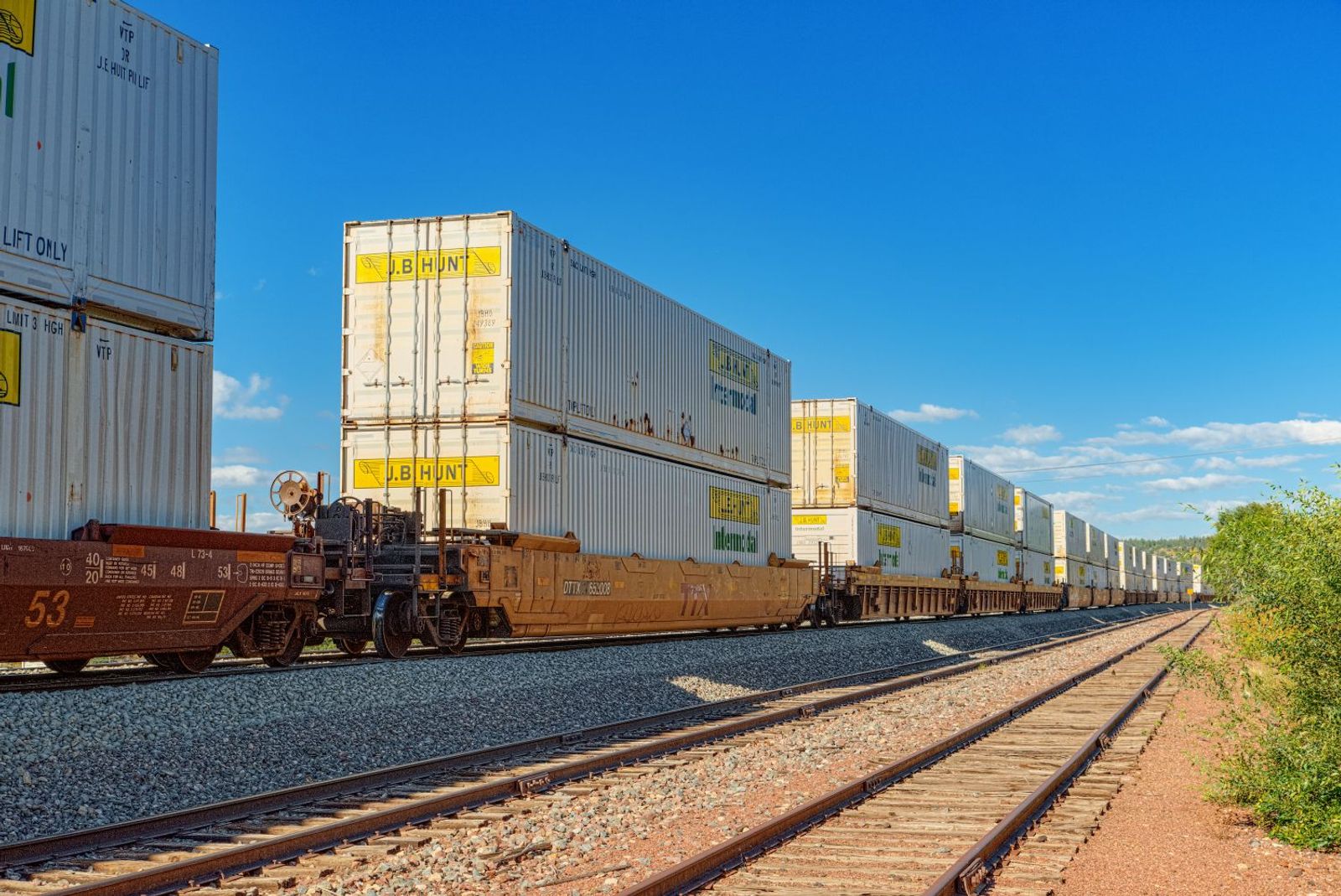
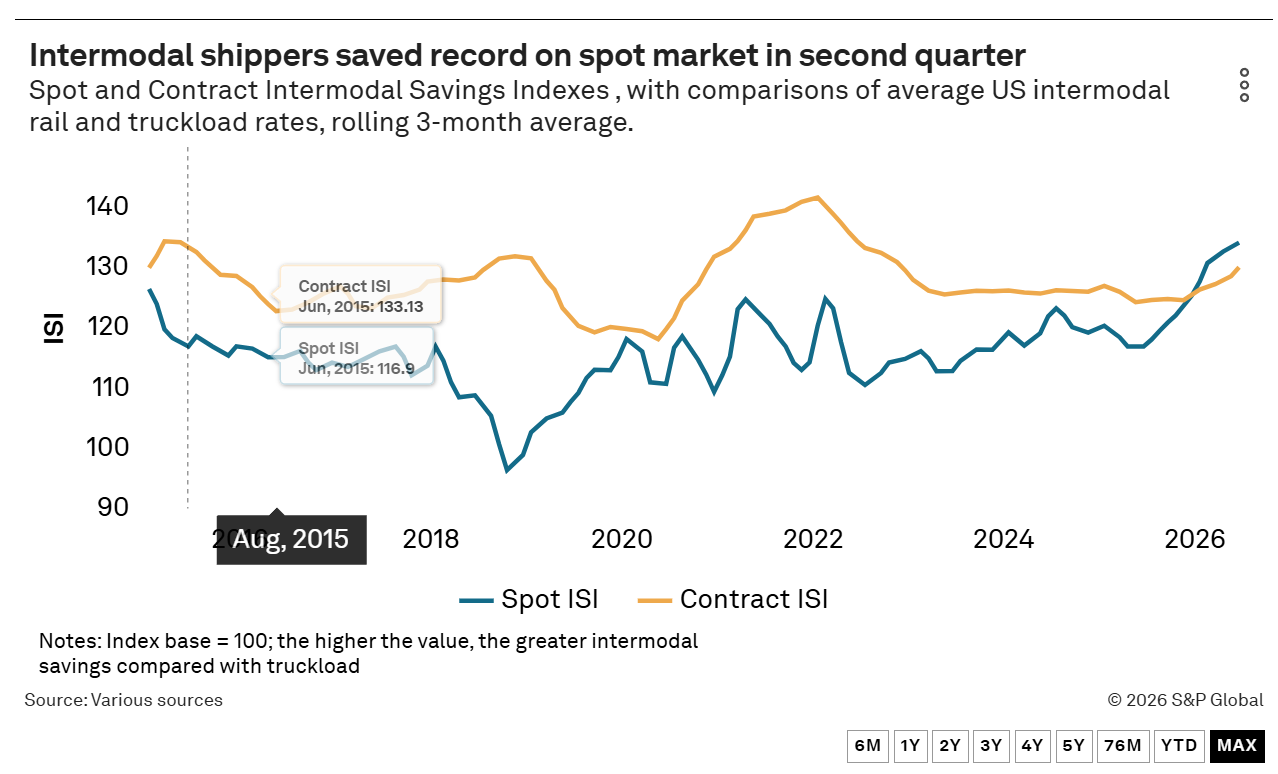
US shippers saved a record 34.1% on spot market freight and 30% on contract loads in the second quarter by using domestic intermodal instead of long-haul trucking, according to the latest Journal of Commerce Intermodal Savings Index (ISI).
Savings hit record levels in the spot market as truckload capacity tightened amid the regulatory crackdown on non-domiciled commercial driver’s licenses and English language proficiency. Exacerbating an already thin driver pool was the US Supreme Court’s May decision in the Montgomery case, which prompted some logistics providers to purge their database of questionable carriers.
Highway rates also rose in the quarter as diesel prices spiked.
Contract intermodal savings also widened as asset-based truckload carriers have reopened agreements signed in the first quarter in order to raise prices. Shippers had little choice as tender rejection rates spiked, causing them to scramble to find trucks or new intermodal capacity to cover loads.
Intermodal contract rates have begun to move upward already, as the top intermodal providers also reject tenders that no longer make economic sense to them. As shippers go deeper into their intermodal routing guides, they must pay more to procure capacity.
North American railroads hauled more than 2.35 million domestic containers and trailers in the second quarter, surpassing the previous quarterly record of 2.30 million loads set in the fourth quarter of 2025, according to the Intermodal Association of North America (IANA).
Domestic volume increased 10.9% year over year in the quarter, the highest growth rate since the second quarter of 2021. Excluding the pandemic, it was the highest growth rate since the end of 2013.
J.B. Hunt Transport Services, the largest intermodal provider in the US, said conversion activity reached levels not seen in more than a decade. It hauled a record of 578,000 loads during the second quarter, up 10% from a year earlier.
Railroads and private-asset-owning intermodal marketing companies (IMCs) responded to the surge by returning previously idled containers to service as quickly as possible. Many of those boxes had remained stacked since being purchased during the pandemic-related freight boom.
Truckload rates widen intermodal savings
The Spot ISI averaged a record 134.1 in the second quarter, up 14.7% from a year earlier. Monthly readings were 133.9 in April, 133.7 in May, and 134.7 in June.
Index values above 100 indicate intermodal is the most cost-effective mode. The higher the index value, the greater the savings. A Spot ISI of 134.1 translates to average intermodal savings of 34.1% compared with truckload on the same lanes.
Spot truckload rates on indexed lanes increased 40 cents from the end of March to $2.74 per mile in June, including fuel. Spot intermodal rates rose 22 cents to $1.86 per mile during the same period.
The Contract ISI increased from 129.2 in April to 129.8 in May and 131.1 in June, producing a second-quarter average of 130.0, up 4.7% from a year earlier.
Average contract truckload rates increased 23 cents from the end of March to $2.48 per mile in June, including fuel. Contract intermodal rates rose only 7 cents to $1.72 per mile.
J.B. Hunt has said the eastern US intermodal discount has widened beyond the typical 10% to 15% fuel-inclusive gap.
Intermodal providers are almost certainly going to push hard for rate increases on the few contracts re-bid in the second half, and then again on most freight that re-bids and becomes effective in the first quarter of 2027.
Service faces first major stress test
The record volume represents the first major stress test for railroad and IMC drayage networks since the pandemic-related freight surge.
Average US Class I intermodal train speeds declined 1.2% year over year to 28.3 miles per hour during the second quarter, according to data from the Association of American Railroads.
The slowdown intensified in June, when average speeds fell 4% from a year earlier. BNSF Railway and Norfolk Southern Railway reported the largest declines. Five of the six Class I railroads reported slower train speeds in June compared with the same month last year. The only exception was Canadian Pacific Kansas City, which was in the middle of service disruptions last summer in the Southeast US.
While higher volume means more revenue for railroads and intermodal providers. It also increases the risk of slower trains, delays in picking up and delivering containers, and other issues related to drayage and equipment.
Intermodal providers have already acknowledged delays in drayage operations in key cities such as Chicago and Dallas, among other locations.
Another record forecast for Q3
The Journal of Commerce forecasts that railroads will haul between 2.33 million and 2.53 million domestic containers during the third quarter, which would set yet another quarterly record.
The model assigns a 99.97% probability that third-quarter volume will exceed the 2.12 million loads hauled a year ago and a 95.1% probability that volume will increase sequentially.
The forecast assumes truckload-to-intermodal conversions will continue as elevated highway rates encourage shippers to seek lower-cost rail capacity.