

Shippers at mid-year are less satisfied with North American intermodal service than they were at the end of 2025, according to the latest Journal of Commerce Intermodal Service Scorecard (ISS), noting how double-digit growth in volume has caused service to degrade from where it was during the freight recession.
Still, satisfaction remains high overall, but the decline is a warning signal for intermodal providers to avoid the unreliable service that angered shippers during the COVID-19 pandemic.
Approximately 87% of intermodal marketing companies (IMCs) were satisfied with railroad service during the first half of 2026, down from 91.3% during H2 2025. Nearly 88% of shippers were satisfied with their IMC partners during the most recent period, down from 93.9% in the last ISS.
The Journal of Commerce survey, conducted in May and June, included more than 160 shippers and IMCs. The lower satisfaction levels came as domestic intermodal volume increased 10.9% year over year in the second quarter, according to the Intermodal Association of North America (IANA).
Railroads hauled more than 2.35 million domestic containers, a new record for any quarter. There is unlikely to be any relief in sight. The Journal of Commerce forecasts a 95.1% likelihood that third quarter volume will grow sequentially, possibly as high as 2.53 million loads between July and September.
“When you start throwing the amount of growth that has come at [railroads] in pretty short order, everyone needs a minute to build their plan,” Darren Field, president of J.B. Hunt Transport Services’ intermodal division, said during a July 15 earnings call. “There will be blips along the way if growth shows up unexpectedly or if we and our customers are unable to forecast it and (can't) communicate what’s coming; that’s what makes me concerned.”
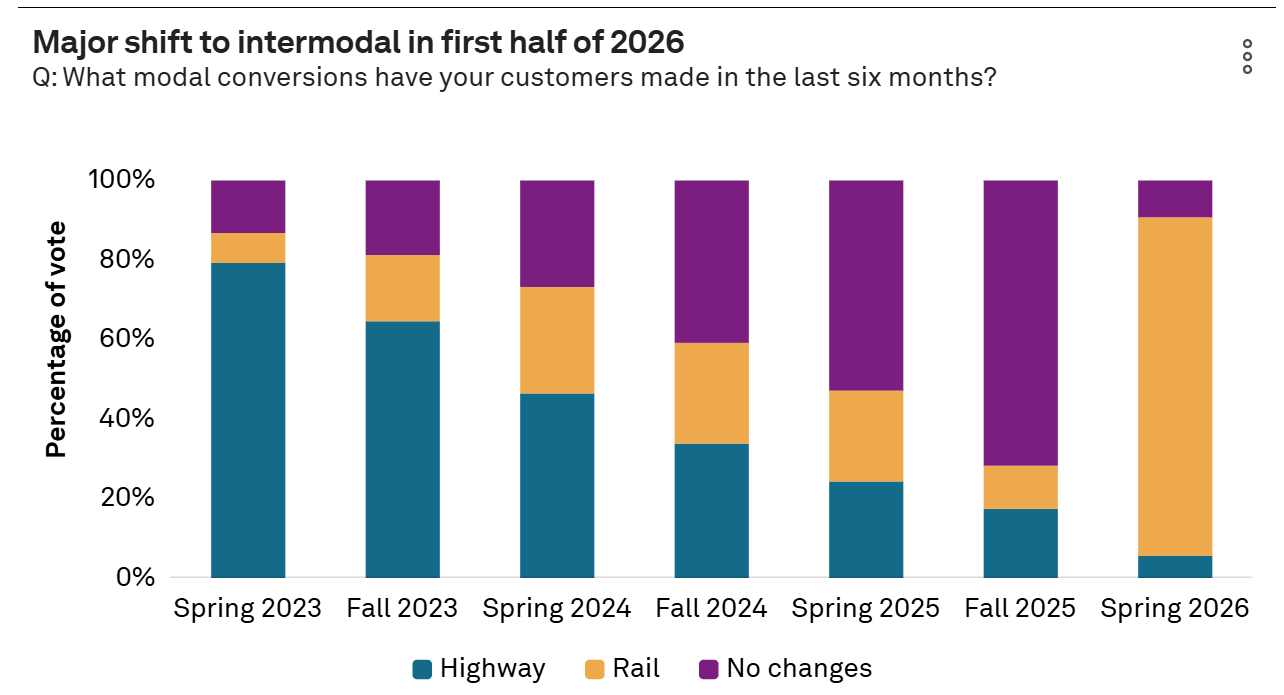
The survey also confirms that rapid modal shift.
More than 85% of IMCs said customers shifted freight from trucks to intermodal during the first half, compared with only 10.9% when asked the same question in late 2025.
More than 54% of shippers surveyed shifted freight to intermodal during the first half, up sharply from 17.5% in late 2025.
But the survey and railroad operating data also showed pressure building late in the second quarter around train speeds, equipment availability, drayage capacity, and on-time performance.
Railroad service slipped late in Q2
UP received 42.6% of the vote when respondents were asked to identify the best performing railroad. However, the detailed scorecard produced a slightly different result, as BNSF received an overall grade of 3.94 out of 5 points, narrowly above UP’s 3.92.
BNSF received the highest scores for ingating and outgating containers, while UP led the railroads in transit performance.
Several respondents credited UP for becoming more aggressive in pursuing truckload conversions to rail.
“UP has been very competitive on truckload conversion freight,” one respondent wrote. “Transits have improved in most lanes. UP also has been more proactive than they have in years past.”
BNSF received strong marks for terminal execution. However, BNSF’s train speed declined 7% year over year during the final eight weeks of the first half, the largest decrease among Class I railroads.
BNSF’s on-time performance fell to 73% in June for one survey respondent, while another said longer transit times required the company to use more containers to move the same amount of freight.
Norfolk Southern Railway also slowed late in the quarter, with its intermodal train speeds declining 5.1% year over year during the final eight weeks of H1. CSX Transportation was also viewed as broadly dependable, although its train speeds declined late in the quarter, similar to its rival NS. Neither eastern US railroad, nor the Canadian railroads, scored as highly in the survey as the western US rails.
Slower service on the US intermodal network in June has been isolated to parts of the intermodal map, not necessarily the whole system.
Canadian Pacific Kansas City (CPKC) remained the lowest-rated railroad for the third consecutive survey. Many customers criticize how long CPKC takes to move loads from Calgary and Edmonton to places such as Toronto because the containers sit at origin for days before getting on a train. Others complained about how long it took to get empties from eastern Canada back to western Canada, pushing customers back to long-haul trucking. Some survey respondents were upset with slow operations in CPKC Bensenville, a terminal near O’Hare International Airport in Chicago.
Shippers worried about drayage, tender acceptance
J.B. Hunt received 45.2% of the vote for best-performing IMC, the most for any provider, but down from 55.9% last fall. Asset-light, non-asset and other IMCs finished just behind at 43.3%.
Shippers, however, highlighted two areas of concern with IMCs: a decline in on-time pickups and deliveries and a rise in tender rejections. Drayage was cited as a major concern.
“We’re leaning in to grow our dray capacity,” Jim Filter, CEO of Schneider, said on a July 30 earnings call. “We’ve already had some success, but most of that growth in our dray capacity occurred at the end of the [second] quarter.”
Nevertheless, it dragged on overall satisfaction in the latest survey. Approximately 88.7% of customers said they were satisfied with J.B. Hunt’s performance, down from 93.3% last fall.
“Technology-wise they are up front and a leader,” one shipper wrote about J.B. Hunt. “What holds them back [right now] is their drayage.”
Dissatisfaction with tender rejections also showed up in the results. In the second half of last year, 100% of shippers said J.B. Hunt met their expectations for tender acceptance levels. In the latest survey, it was 85.5%.
Late last year, 85.7% of shippers said Hub Group met expectations for tender acceptance; in the latest survey, it was 69.1%. Schneider saw a nearly identical drop to Hub Group.
Shippers noted that intermodal conversions require railroads and IMCs to provide equipment, drayage capacity, and on-time pickup and deliveries, not simply replacing one rejection with another.
Winning freight from trucking is only the first step. Keeping it will require railroads and IMCs to be able to absorb higher volumes without performance suffering, thus demonstrating to shippers that intermodal is not sliding back toward the unreliable service of 2021 and 2022.