

US shippers suffering from truck pricing whiplash are turning to short-term contracts called mini-bids as never before, hoping to secure capacity ahead of rate hikes.
It is a sign of how competitive and volatile the US freight market is becoming as trucking’s peak fall season approaches, rates continue to climb and available capacity shrinks.
The trend also underscores how the collapse of truckload capacity is creating a marketplace focused on the short-term, rather than long-term needs and relationships.
Trucking executives, analysts and procurement experts say the use of mini-bids is accelerating as annual contracts fail to keep pace with the freight market.
”Mini-bid and turnback bid activity is persisting, if not increasing,” Knight-Swift Transportation Holdings CEO Adam Miller said during an earnings call last month.
Werner Enterprises is seeing “large-scale, kind of mini-bids and rebids of routing guides that have blown up,” CEO Derek Leathers said during his company’s July earnings call.
For many shippers, procurement is becoming more dynamic as they respond to rapidly changing capacity and pricing conditions.
"I'd almost like to get rid of the mini-bid term," Spencer Frazier, executive vice president of sales and marketing at J.B. Hunt Transport Services, said during a recent earnings call. "They are structurally large bids as customers are competing for capacity to reset their networks."
Joel Goldstein, chief executive of retail distributor Mr. Checkout, said retailers are seeing more mini-bids and shorter contract terms as freight markets tighten.
”There are many more mini-bids being offered,” Goldstein said. “We’re seeing shorter contracts. There is a lot of uncertainty. There is a lot less capacity.”
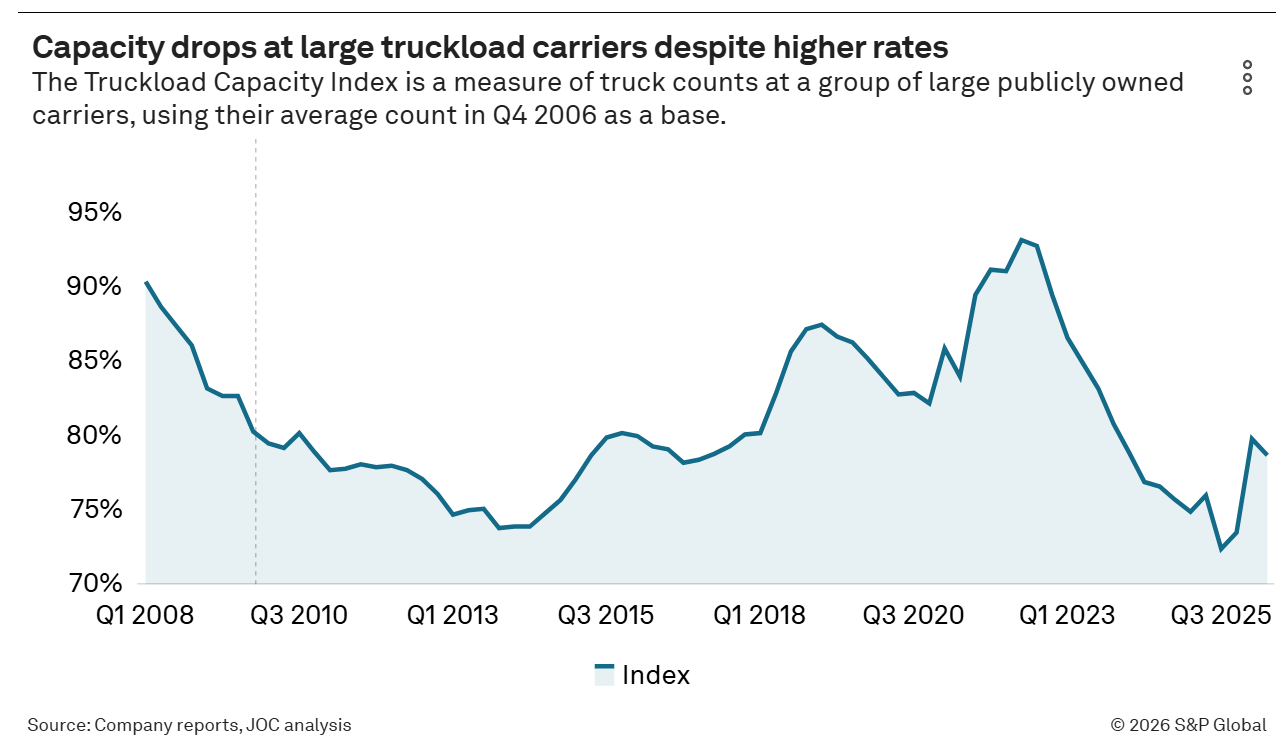
The Journal of Commerce Truckload Capacity Index (TCI) fell 1.1 percentage points, to 78.7 in the second quarter from the first quarter, with large carriers holding the line on fleet expansion.
Chris Caplice, executive director of MIT FreightLab, said mini-bids should not be viewed as replacements for annual transportation bids.
”This is not new,” Caplice told the Journal of Commerce. “I’ve heard the term mini-bids since I was a doctoral student in the mid-1990s.”
Mini-bids are becoming more visible because the market is shifting, revealing “gaps” in capacity within shippers’ distribution networks, he said.
“The annual RFP [request for proposal] is about effectiveness,” said Caplice. “When I talk about a mini-bid, it’s all about efficiency — how fast can I fill this gap in my routing guide?”
Faster targeted bids
Caplice describes mini-bids as a tactical procurement tool designed to solve specific problems. “A mini-bid is not just a little RFP,” he said. “It’s a different process.”
Annual requests for proposals are designed to optimize an entire transportation network over 12 months. Mini-bids, by contrast, fill immediate needs — whether replacing carriers in a failing routing guide, securing capacity for a seasonal surge, or responding to changing market conditions.
“Whenever one side of the market — the shippers or the carriers — feels the market is not favorable to them, it’ll shorten the cycles and they’ll do mini-bids in the middle,” Caplice said.
Unlike annual bids, mini-bids have no standard duration. Some last only weeks while others bridge the gap until the next annual procurement cycle.
Many shippers are using mini-bids to break large procurement events into smaller regional bids that allow transportation managers to react more quickly to changing conditions, said Mike Regan, chief relationship officer and co-founder at TranzAct Technologies.
”They’re creating variability into their sourcing process,” Regan said. “They don’t have to make decisions about their entire freight spend. They can focus on one geographic area at a time.”
Instead of rebidding an entire transportation network, a shipper may seek pricing only in the Northeast or Southeast, reducing the amount of data that must be analyzed while targeting regions where pricing or capacity has shifted.
Regan said he sees the practice most often in less-than-truckload (LTL) transportation because of that sector’s concentration of national and regional carriers, although Caplice said the strategy is also common in truckload procurement. “I don't know anyone who does a national mini-bid,” Caplice said. “That kind of defeats the purpose.”
Capacity driving change
Carrier executives say today’s mini-bids are being driven less by cost savings than by the need to secure dependable capacity.
”Unlike the past few years, shippers are generally not issuing off-cycle bids opportunistically to improve service or drive prices lower,” Knight-Swift’s Miller said. “These actions are driven by a need to secure capacity.”
Werner’s Leathers said customers are returning after freight awarded elsewhere could no longer be serviced under existing pricing, while J.B. Hunt’s Frazier said customers are facing “significant challenges across their routing guides.”
Avery Vise, vice president of trucking at FTR Transportation Intelligence, said contract pricing is now following the recovery in the spot market.
”We expect contract rates will continue to rise pretty much into the third quarter of next year,” Vise told the Journal of Commerce, with low double-digit increases expected across most equipment types if current market conditions persist.