

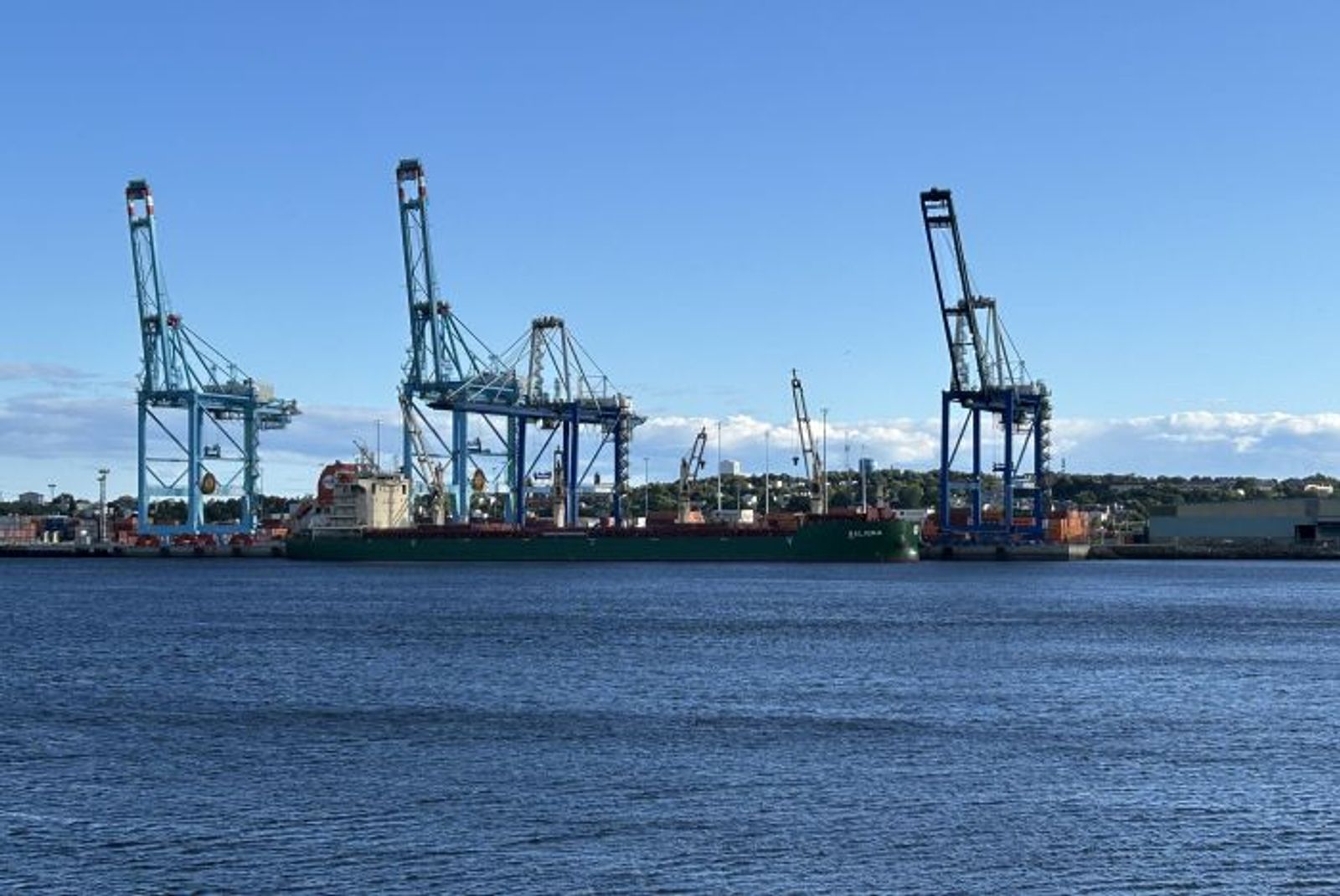
Canada's Port of Saint John has completed a four-year project to upgrade its marine terminal that will quadruple its container handling capability; allow it to handle large, post-Panamax ships; and provide more intermodal rail capacity.
The Port of Saint John said Tuesday that the C$247 million project at DP World's Westside terminal was completed in December. The two-phase project — funded primarily by the port along with the province of New Brunswick and Canada's Transport Ministry — has brought Saint John's nominal capacity to 800,000 TEUs, up from 150,000 TEUs in 2021.
The main feature of the work, part of the project's first phase, is an additional 1,131-foot berth with a 56-foot depth alongside, allowing Saint John to handle vessels of 10,000 TEUs or larger. The largest ship that currently calls Saint John is approximately 7,000 TEUs. Saint John said it also increased laydown and yard space at the terminal.
The terminal will also have expanded track capacity for building longer intermodal train blocks, making it capable of building blocks of roughly 8,000 feet, up from the original 3,000-foot length.
The Port of Saint John is served primarily by Canadian Pacific Kansas City (CPKC), which has the shortest track distance between the port and eastern Canada's major cities. But it also has service from Canadian National, as well as southbound connections into the US via CSX Transportation.
The port said completion of the first phase of the project has already resulted in a 400% year-over-year increase in its container throughput, to 240,000 TEUs in 2025.
Aligns with federal investment plan
Although planned years ahead of time, Saint John's terminal upgrades are aligned with the Canadian government's goal announced in Noveber of investing C$5 billion in trade infrastructure, the port's statement said. The investments in new trade infrastructure stem from Canada's move to lessen its trade reliance on the US.
Saint John “is a national asset that will help move more Canadian goods to global markets, more efficiently and reliably,” Canada's Minister of Transport Steve MacKinnon said in the statement.
Saint John primarily serves Canada's trans-Atlantic trade, with vessel transits from European ports making up the majority of its vessel calls, according to data from Sea-web, a sister product of the Journal of Commerce within S&P Global. The port also serves as a gateway for eastern Canada's north-south trades with South America and the Caribbean.
Saint John is also boosting its cold-chain capacity, with Americold building a refrigerated warehouse just outside the port that will connect to CPKC's network.