

US importers are frontloading shipments on the eastbound trans-Pacific in a race to head off rising bunker fuel surcharges, price hikes from Asian suppliers and a new round of tariff uncertainty. And now that demand surge is causing spot rates to jump sharply and capacity on the trade lane to tighten, sources in the market say.
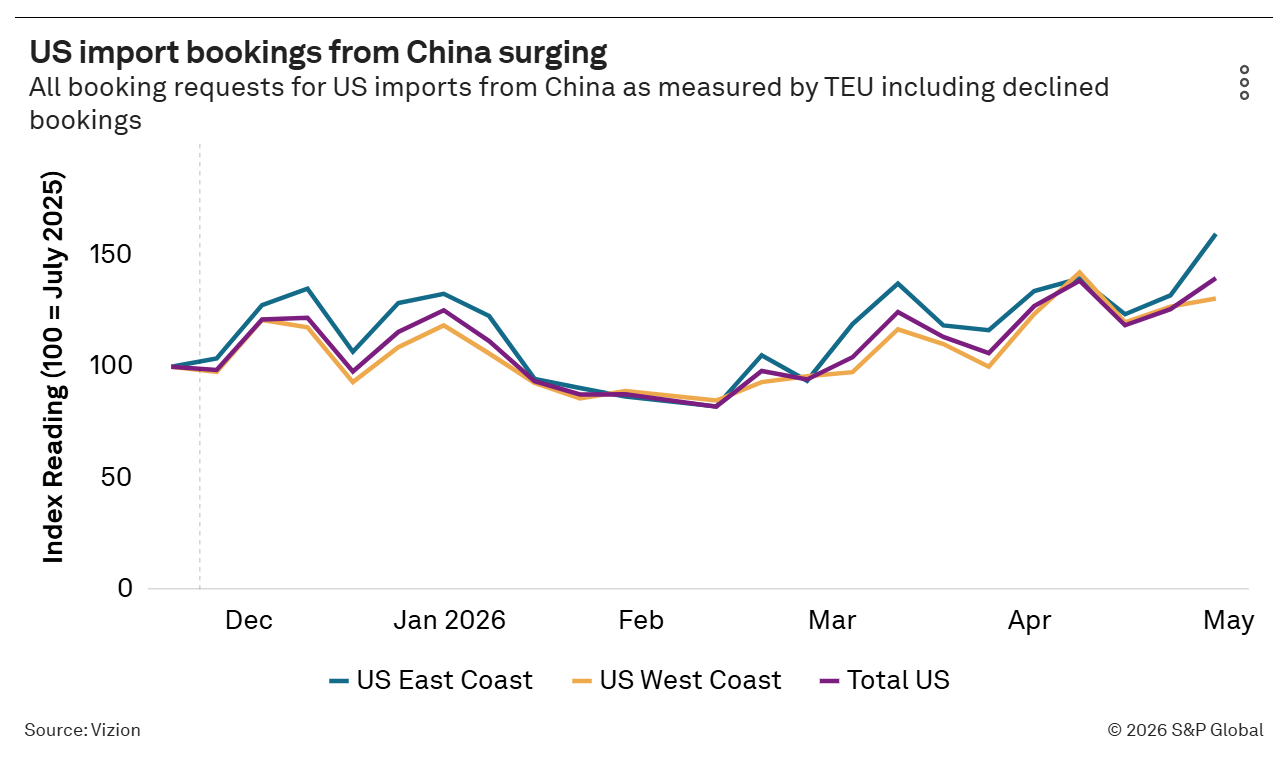
Capacity has become tight enough that forwarders are warning customers they must book at least three weeks in advance amid the surge in frontloading of fall and end-of-year holiday merchandise. US import bookings from China and Southeast Asia increased 11% and 10%, respectively, for the week ending May 11, according to data from Vizion, the most recent available.
Emboldened by the increased demand, ocean carriers levied peak season surcharges (PSSs) of $500 to $1,000 per FEU effective June 1. At least two carriers have announced additional PSSs of $1,200 to $2,000 per FEU effective June 15, one source said.
Patrick Fay, CEO of trans-Pacific forwarder BOC International said the increased demand stems in part from uncertainty among shippers about possible further tariff moves by the Trump administration. Following the Supreme Court’s decision to strike down President Donald Trump’s widespread tariffs implemented in April 2025, the US Trade Representative imposed temporary Section 122 tariffs on all imports, with those tariffs set to expire July 24.
“No one predicted this surge, and most forecasts were conservative this year,” Fay said.
Shippers are also racing to get ahead of expected price increases from Asian suppliers. The S&P Global Market Intelligence Purchasing Managers’ Index™ (PMI®) released last week saw readings on price pressures and supply shortages reach highs not seen since 2022 as the war in the Middle East keeps the price of oil and related commodities elevated.
In a May 29 market update, BOC International said shippers should expect an “extremely tight space situation and significant increases in ocean freight rates” this month. Fay told the Journal of Commerce the demand surge has caught shippers off guard and “many are scrambling for capacity now.”
Shippers are being advised that container space during June out of Ningbo, Qingdao, Xiamen and Southeast Asia is extremely tight, with space only available four or more weeks out. Even premium trans-Pacific express services are sold out through June.
“Freight rates have entered a rapid, upward channel, and low-priced space has essentially vanished,” an executive for a New Jersey-based third-party logistics provider said.
Ocean carriers are generally honoring contracted cargo and holding shippers to their minimum quantity commitments (MQCs), sources said. For the freight-all-kinds (FAK) market, carriers ceased weeks ago offering so-called bullet rates, where lower freight rates were available for select voyages.
Carriers adding capacity
The capacity discipline fits a larger pattern of carriers being more margin-focused and increasingly interested in higher-yield cargo at the expense of traditional contract structures, said Serkan Kavas, executive vice president for imports at the forwarder MTS Logistics.
“Nobody knows whether [the volume surge] will be here to stay for the longer term or temporary, but for the next few weeks overall it will be really busy [on the eastbound trans-Pacific],” he said.
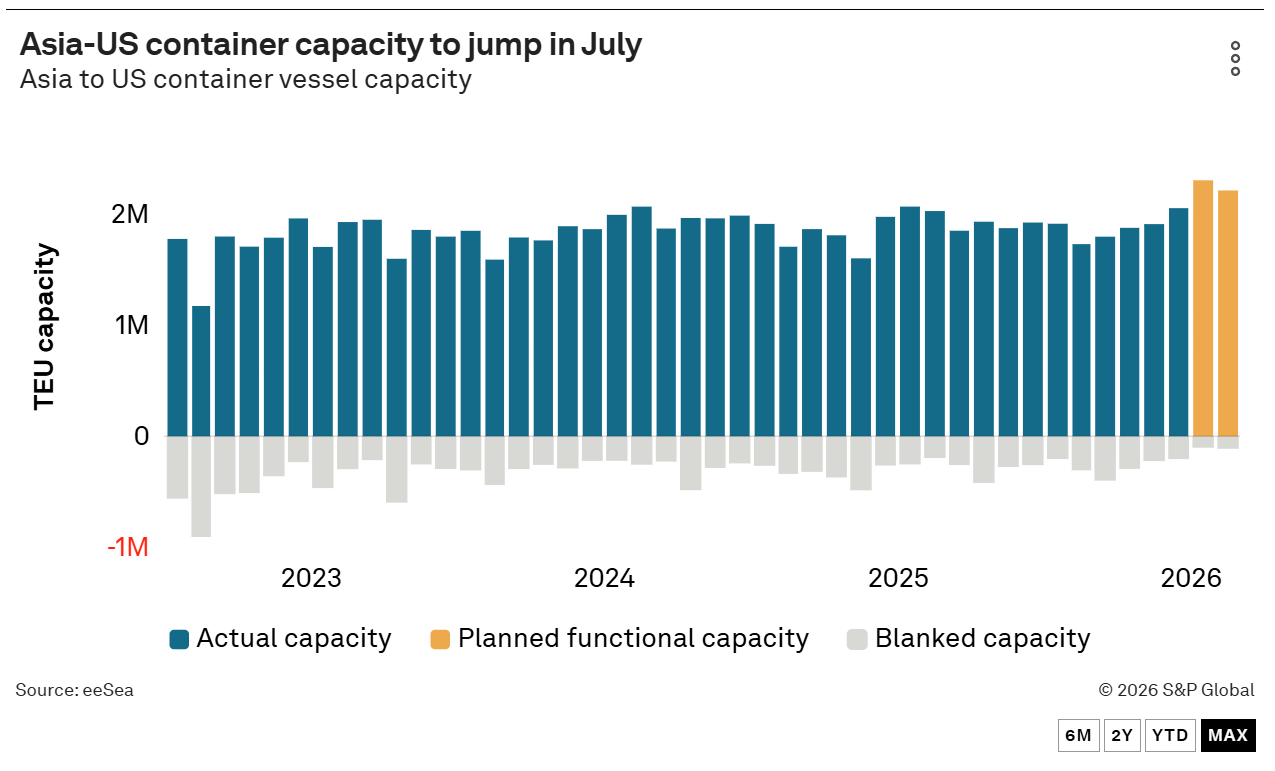
Still, ocean carriers plan to add more capacity in July on the Asia to US trades, with planned functional capacity at nearly 2.3 million TEUs, the highest in at least three and a half years, according to data from benchmark provider Xeneta’s eeSea. That’s up from approximately 2.1 million TEUs in June and 1.94 million TEUs in May.
Generally, though, the real tipping point in the trans-Pacific came in April, when carriers began to implement emergency bunker surcharges (EBSs) after the 30-day advance filing requirement by the Federal Maritime Commission took effect, a carrier executive told the Journal of Commerce.
“That is when the spot rate took off,” the source said. “That’s the biggest factor because the shipping lines are hell-bent on recovering their costs, for all the good reasons.”
The executive noted that bunker fuel prices in some markets have jumped more than 70% since the war in the Middle East began. “The cost increases are real,” he said.
A second carrier source said the EBSs are “internally justifiable” among liners. “It is easier to get them through their organizations without some type of fight,” the source said.
Carriers have also already begun to implement PSSs about a month earlier than they have in recent years.
“Every carrier has come forward and asked their shippers for it,” the second carrier source said, although he acknowledged some customers are resisting.
“A month ago you were begging me to sign a contract for $1,700 to $1,800,” the source said customers are telling their core carriers. “Now I have to pay a peak [season surcharge] of $1,000 and a bunker charge?”
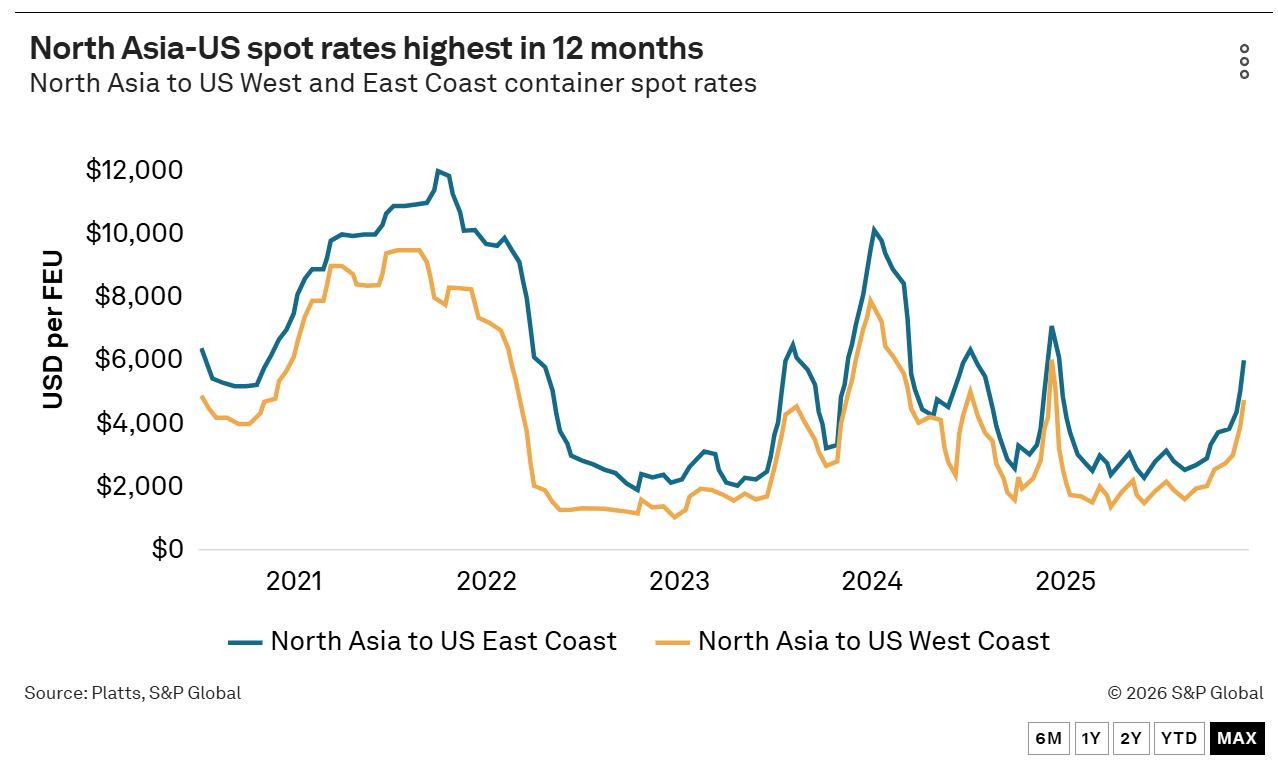
Spot rates, meanwhile, continue to rocket higher. Rates from North Asia to the US East Coast hit $6,000 per FEU as of June 1, up 19% in one week and the highest in 12 months, according to Platts, a sister company of the Journal of Commerce within S&P Global. Rates to the West Coast of $4,500 per FEU are also at their highest in a year and up 15% on the week.
Hormuz disruption
Factories in Asia are running hot now, with the global PMI expanding at the fastest rate in five years, “amid reports of clients frontloading purchases to mitigate expected price rises and supply chain disruption,” according to the latest report from the JP Morgan Global Manufacturing PMI.
That disruption is driven by the war that is entering its fourth month, with a fragile ceasefire seemingly hanging by a thread.
“The effective closure of the Strait of Hormuz has severely disrupted supply chains and the delivery of a range of commodities, with the impact most keenly felt in oil markets,” S&P Global economist Usamah Bhatti said in the PMI report. “Packaging, polymers and transport also saw a marked number of reports of shortages.”
A backlog of container ships, among other vessels, inside the Strait of Hormuz is also causing shortages of empty containers available at origin sites, BOC’s Fay said. Along with shippers, ocean carriers are said to be looking to lease more containers to meet the rising demand but are finding lessors mostly sold out currently.