

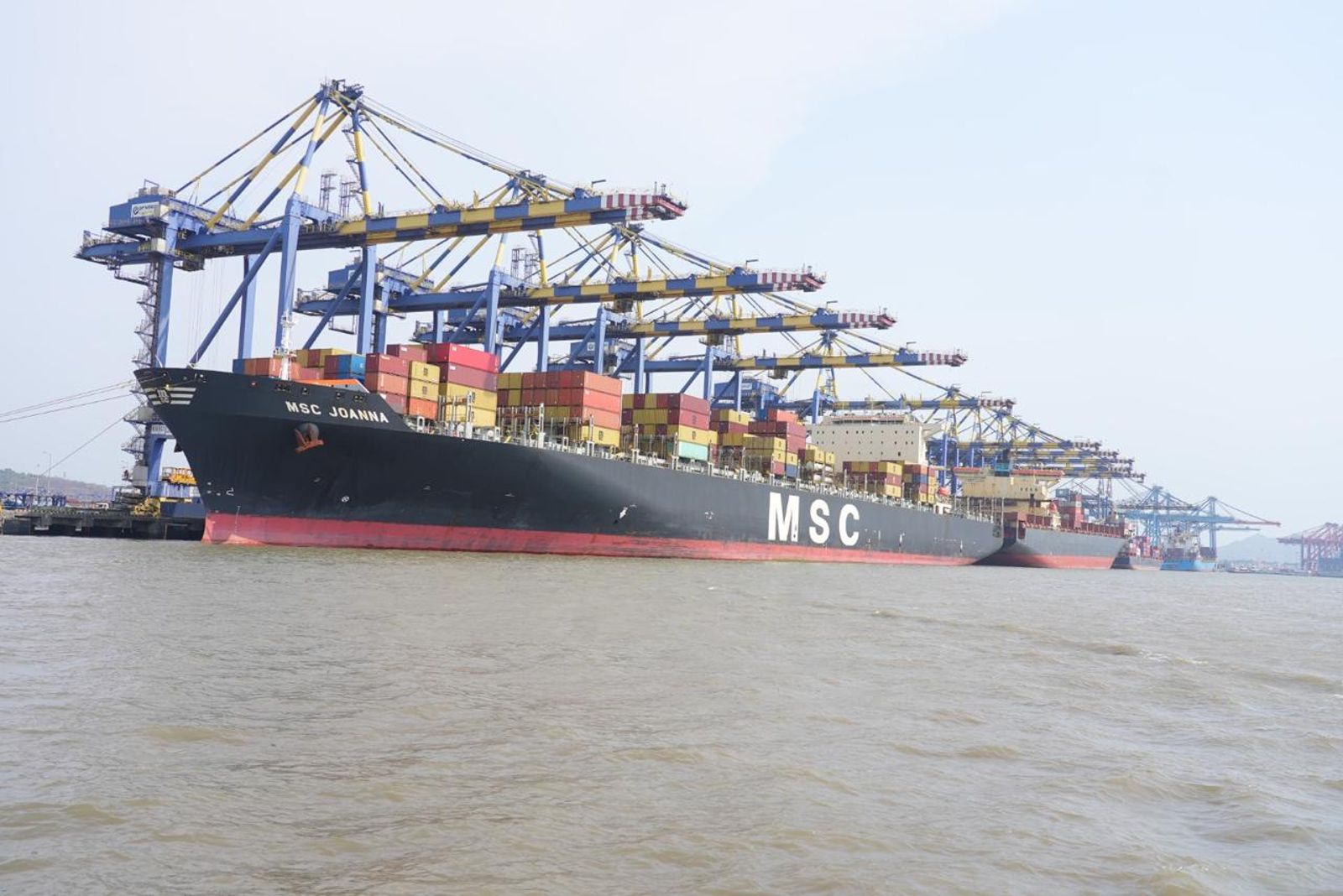
Ocean carriers operating on the India-US East Coast (USEC) trade lane have been able to push rates significantly higher in June, seizing on the opportunity presented by lower capacity and rising demand, market sources say.
Space availability on the lane has tightened as a result of Mediterranean Shipping Co. (MSC) withdrawing its Indus Express service, while other competing networks reported schedule disruptions — six blank sailings between weeks 25 and 29 across Hapag-Lloyd’s TPI, CMA CGM’s Indamex and Ocean Network Express’ WIN services.
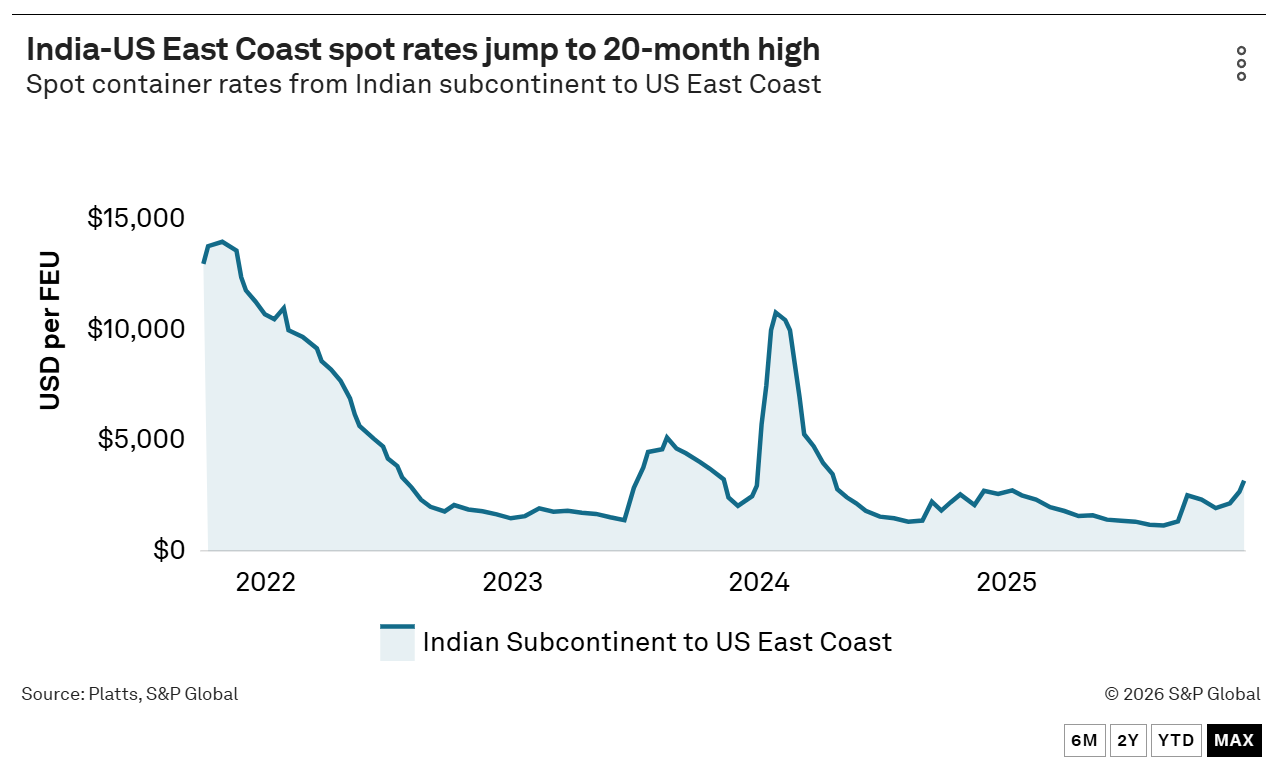
Average freight-all-kinds (FAK) rates on the trade have climbed roughly $1,000/FEU month over month, forwarders say. Booking rates from western India (Nhava Sheva/Mundra) to New York now stand at $3,400-$3,600/FEU, highest in more than 18 months, data shows.
Platts, a sister company of the Journal of Commerce within S&P Global, assessed India-USEC spot rates at $3,200/FEU as of June 15, a 19% gain on the week and the highest since mid-October 2024.
After netting full recovery of the proposed early-June increases, carriers are now betting on heftier rate attempts for July, including a $4,000/FEU peak season surcharge announcement by CMA CGM beginning July 10.
“Carriers have already filled available sailings for [June],” said a Mumbai-based forwarder executive who did not want to be identified.
That said, forwarders do not believe carriers can flex their pricing muscles so aggressively unless market fundamentals dramatically change.
‘Surge in bookings’
Indian exporters have faced an increasing number of cargo rollovers in recent weeks due to the capacity squeeze, with trade complaints in large part pointed to Maersk’s Middle East Container Line (MECL) string.
But Bhavik Mota, Maersk’s director of regional ocean management for India/Middle East/Africa, told the Journal of Commerce that shifting supply-demand dynamics are to blame for the current loading pressures even as MECL sailings continue at full steam.
“We are seeing demand strengthen on the India-US trade route,” said Mota. “That, combined with capacity constraints in the market, is leading to a surge in bookings.”
A Bangalore, India-based forwarder handling regular solar inverter shipments for a US importer confirmed that it is booking two to three weeks in advance to secure space on MECL sailings out of Nhava Sheva.
Another US importer source who did not want to be identified said that amid the current volatility, named account contract (NAC) shippers remain “rate protected” if they are able to find space.
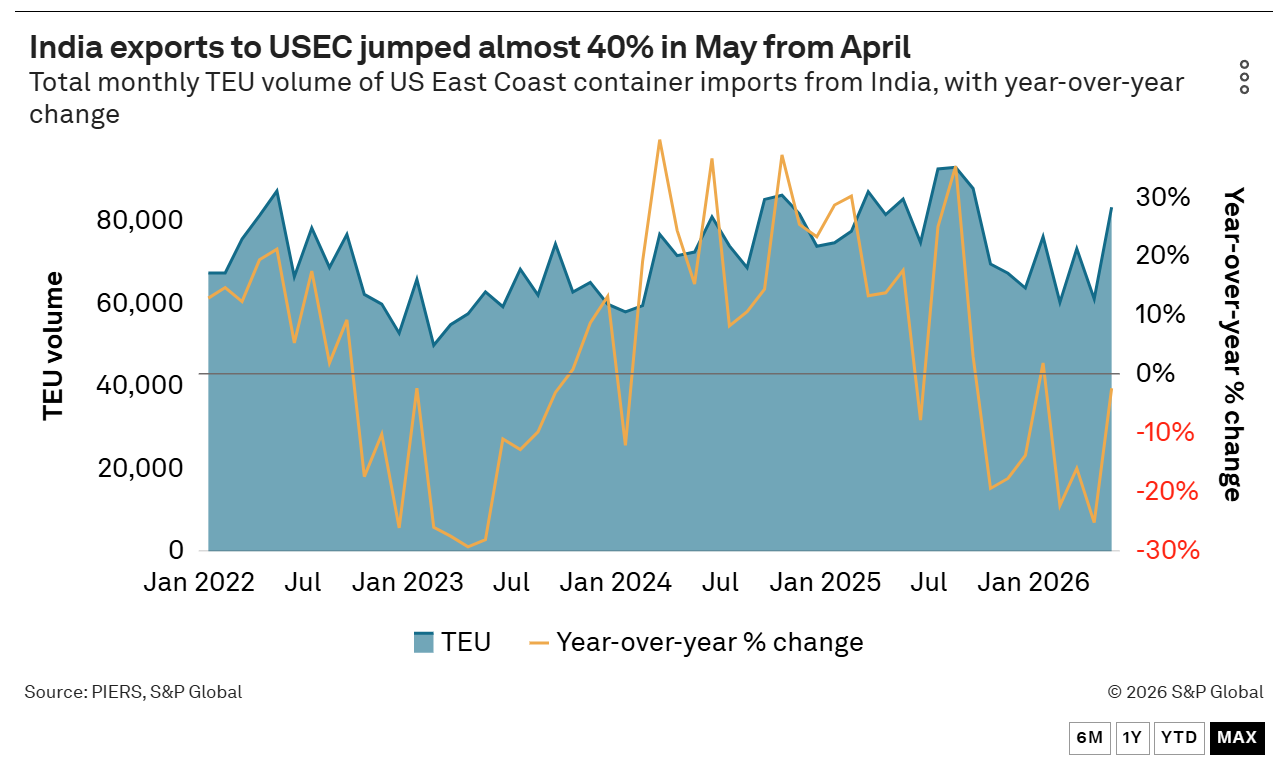
That comes after Indian exports to the US East Coast in May jumped to 83,470 TEUs, up almost 40% from April and the highest since last September, according to PIERS, a sister product of the Journal of Commerce.
July India-USEC sailings already open to spot bookings indicate rates near $4,800/FEU through the first half and $5,800 for the latter part, sources noted.
“The key question is whether these increases can be sustained once the current round of frontloading eases,” said Ashish Sheth, chairman and managing director of Sarjak Container Lines. “At this stage, the market is certainly firmer than it was earlier in the year, but long-term pricing power will ultimately depend on underlying demand rather than temporary disruption-driven factors.”
Niels Nielsen, CEO of North America for ECU Worldwide, told the Journal of Commerce that notwithstanding the potential reopening of the Strait of Hormuz, trade volatility persists.
“With hundreds of vessels currently waiting or facing disruptions [in the Persian Gulf], it could take another two to three months for shipping schedules, capacity, and cargo flows to stabilize,” Nielsen said. “In such periods of uncertainty, supply chain resilience and agility become critical.”