

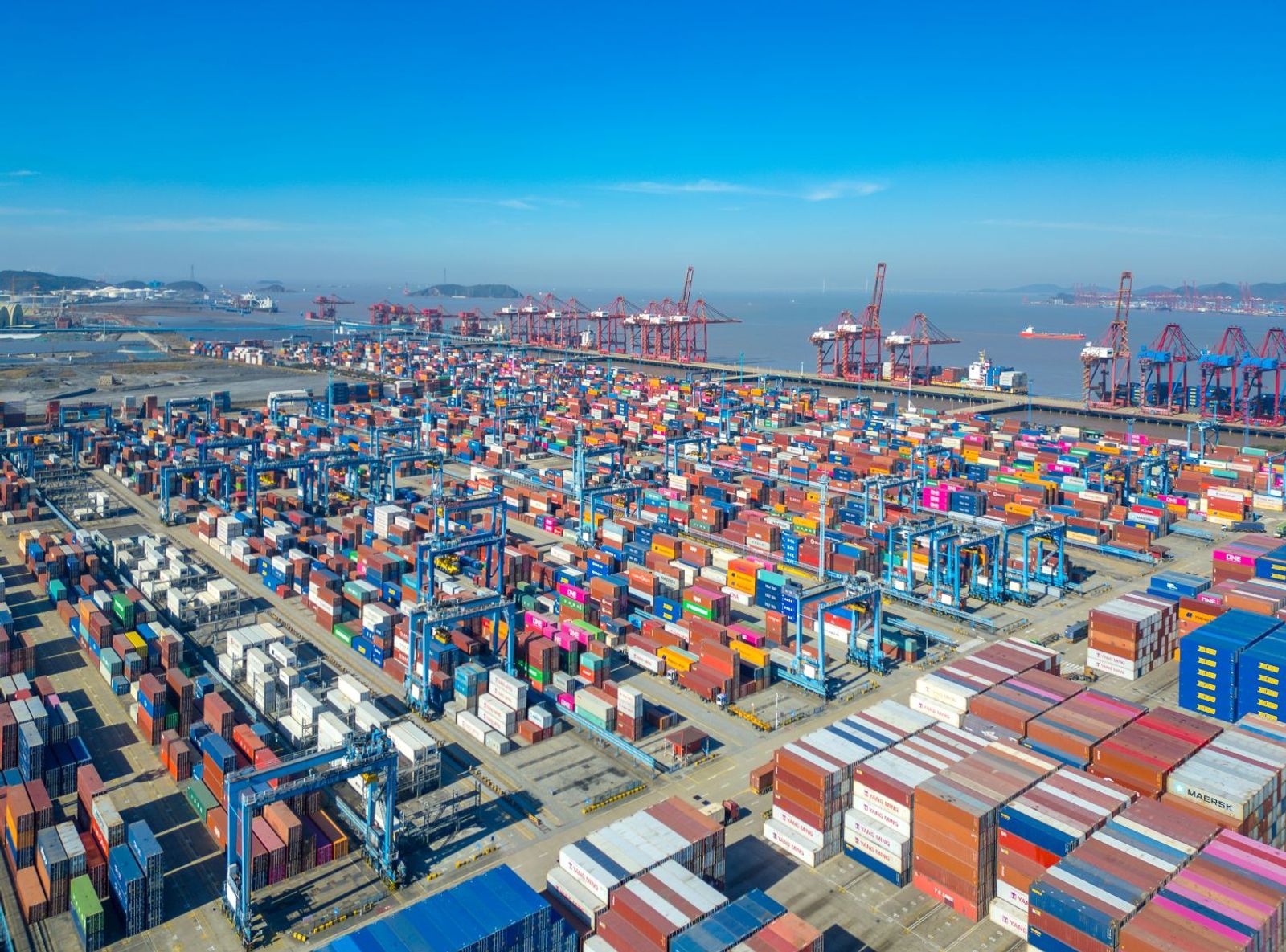
Shippers and ocean carriers are facing widening disruption in Asia after Typhoon Saudel hit eastern China late last week, becoming the latest in a string of storms to wreak havoc on port operations and shipping schedules in the region.
Sources say there are growing instances of transshipment, rolled cargo and skipped calls in the wake of Saudel, while yard density at ports in north and east Asia is becoming another chokepoint.
The disruption, meanwhile, helped put fresh upward pressure on ocean rates. According to Platts, a sister company of the Journal of Commerce within S&P Global, spot rates from North Asia to the US West Coast were pegged at $7,900 per FEU as of Monday, up 2% on the week and the highest on the trade lane since June 2022. East Coast rates at $11,500/TEU were 1% stronger and the highest since April 2022.
After forcing the closure of Shanghai and Ningbo between Aug. 26 and Aug. 28, Saudel made landfall south of Xiamen and moved in a southwesterly arc to Hainan Island close to northern Vietnam. Saudel is now looping back northeastward along the China coast and is on track to affect Shenzhen and Xiamen next weekend, according to the latest forecast from the Hong Kong Observatory Monday.
China’s Transport Ministry on Monday warned of further weather problems that could potentially disrupt transport and inland supply chains. It said torrential rain and strong winds due to Saudel will affect a broad swathe of eastern and southern China from Jiangsu west of Shanghai to southern Guangdong and Hong Kong. Taiwan will also be affected.
Saudel hit three weeks after Typhoon Dolphin closed Shanghai and Ningbo for nearly four days earlier this month.

“The operational problem is that schedule recovery does not remove the disruption; it redistributes it,” Hugo Hernandez, founder of logistics advisory company Contract Breakpoint and the company’s senior logistics adviser, told the Journal of Commerce. “Port omissions and extra transshipments may recover the vessel schedule, but they can leave cargo facing additional handoffs, equipment imbalances, yard congestion and rolled connection long after the original port closure has ended.”
Hapag-Lloyd said in a regional update Sunday that cargo on two Gemini Cooperation Asia-Europe services would be double-transshipped as ships omitted Shenzhen’s Yantian terminals.
The carrier said the affected sailings are the 19,870-TEU Tihama operating Gemini’s Asia North Europe 2 service and the 17,480-TEU Brisbane Maersk deployed on the Asia South Europe 2 loop. Import cargo for Yantian on both ships would be unloaded at Tanjung Pelepas in Malaysia and transshipped to Singapore and then transferred again to Yantian.
Cargo on several other Gemini Asia-Europe and Hapag services would be transshipped as vessels skipped both Shanghai and Ningbo, plus Busan and Yokohama, which were also affected by Saudel. Hapag said cargo on some Gemini trans-Pacific sailings would be rolled due to port omissions in China.
The queue of vessels in Shanghai numbered 90 as of Aug. 24, according to data from Portcast. That was down from 107 on Aug. 17, but the number is likely to rise again once the effects of the new storm take hold.
Fresh delays at Shanghai, Ningbo
Hapag-Lloyd said the average waiting time for ships operating Gemini services calling at Shanghai has increased to between five and 10 days depending on the size of the vessel and seven to 11 days on non-Gemini services. That compared with about five days before the storm hit.
Meanwhile, the delays in Shanghai have led the Premier Alliance to temporarily drop the port from 11 trans-Pacific sailings between now and early-October.
Five sailings on its East Coast loop 2 (EC2) between Aug. 29 and Oct. 9 and four on the EC4 service from Sept. 2 and Sept. 26 would not call at Shanghai, Premier member Ocean Network Express (ONE) said in an advisory. ONE said the omissions are being made “for schedule recovery,” while Shanghai cargo will be transshipped via Busan.
HMM vessel schedules show 12 ships were directly affected by the closure of Shanghai, while the arrival of at least another 20 ships was impacted after the port reopened.
Hapag-Lloyd said wait times at Ningbo are up to five days for Gemini services and three to six days for non-Gemini loops.
For ships calling at Shenzhen’s Yantian terminal, forwarder Kuehne + Nagel said there is a wait time of three to six days depending on the size of the vessel.
Seko Logistics said Saudel caused a four-day closure of Japan’s Shimizu port and a three-day suspension of operations at Naha.
Yard density levels are becoming elevated, with up to 95% utilization at Yokohama, up to 90% at Westports in Port Klang, Malaysia, and 80% at some terminals in Busan, Seko Logistics said.
“When several disruptions arrive in quick succession, each recovery measure starts interacting with the residue of the previous one. That is how a weather event lasting days can create cargo execution problems that persist for weeks,” Hernandez said.